Countertop edge profiles: 18 types, and how to choose one
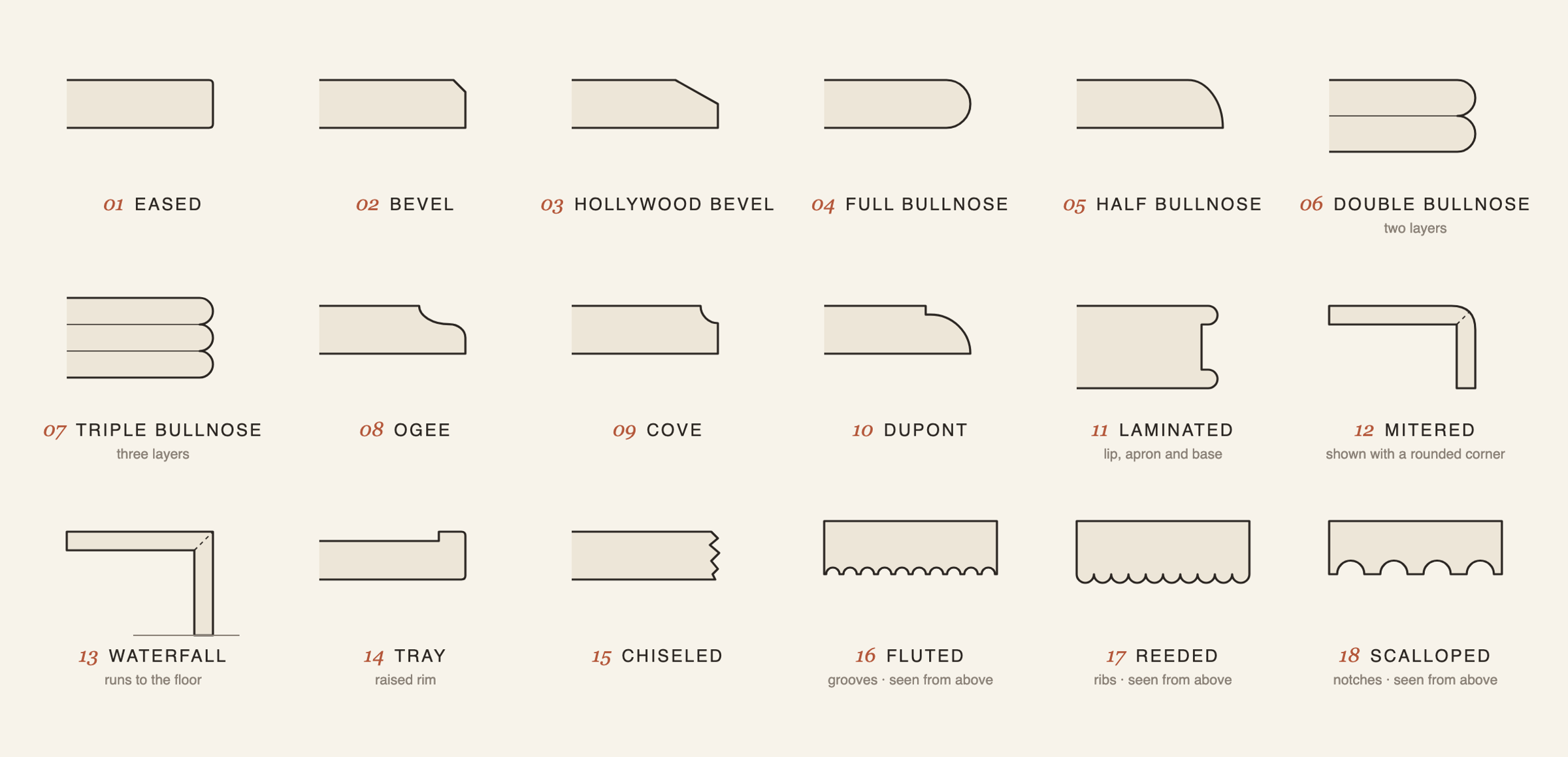
The edge is the part of a countertop you touch and see most. Here are 18 profiles, from eased and bullnose to ogee, mitered and fluted, with what each suits and costs.

A countertop edge profile is the shape cut into the exposed edge of the slab. It changes how the room reads: a square, thin edge reads modern, a moulded edge reads traditional, a thick edge reads generous. It also changes how the counter wears and cleans. Sharp corners chip and rounded ones don't; grooves and steps collect crumbs, flat and rounded edges wipe clean.
Edges are priced per linear foot. Simple profiles are usually included in the fabrication price; moulded, built-up and carved edges add labour. Cost below is on a four-step scale, from $ (usually included) to $$$$ (custom work), because the figure moves with the stone and the shop. If you're unsure, an eased edge on a 3 cm slab is never wrong.
Thickness matters too. Moulded and decorative edges need a slab of about 3 cm (1¼ inches) or more to have room for the shape; on a thinner slab, choose a simple edge or have the edge built up.
In this guide
Simple edgesEdges that are mostly absent
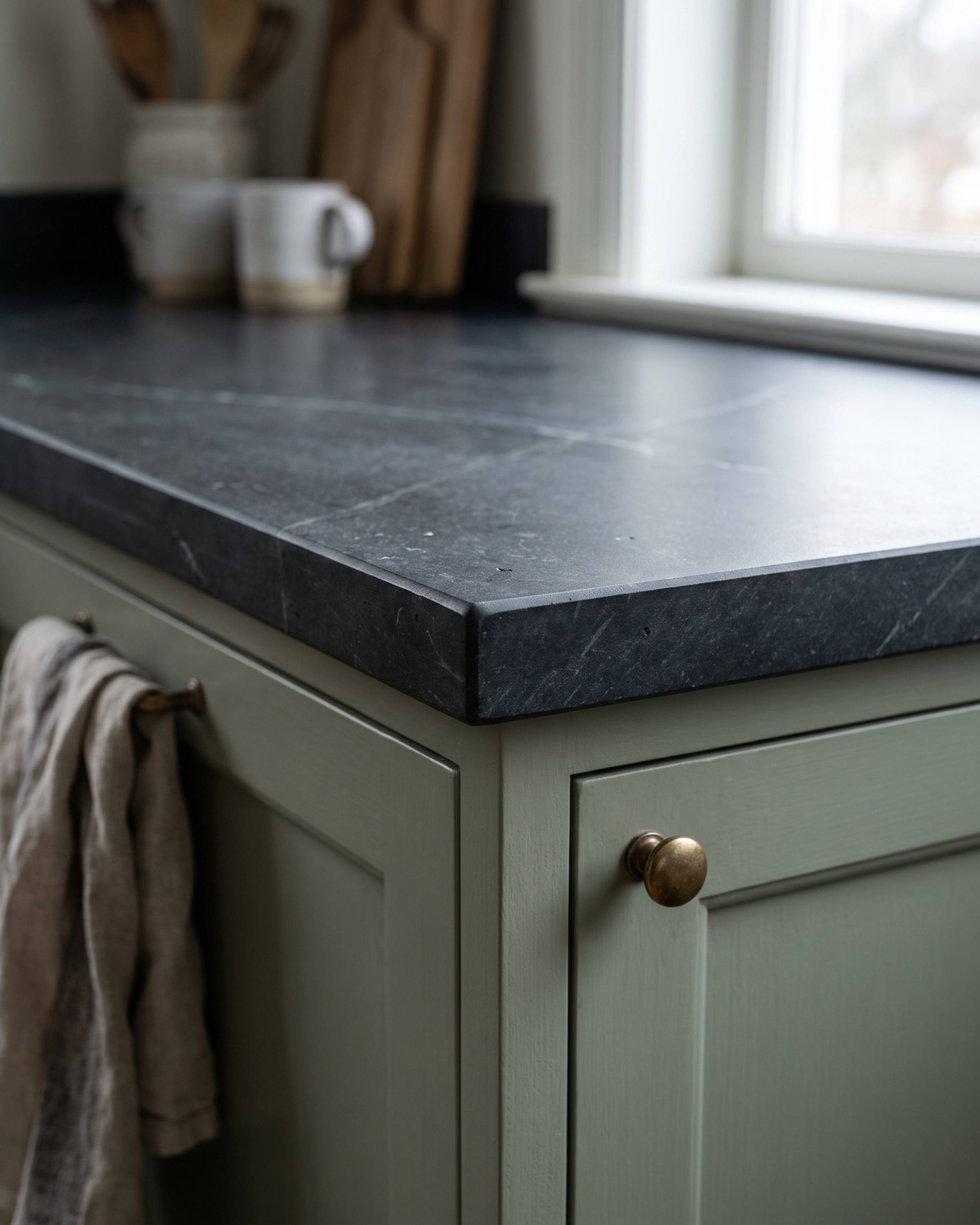
Eased
- What it is
- A square edge with the sharp corners just softened. Also called a straight or square edge.
- Suits
- Every style; the default for a calm, modern or transitional kitchen. Any stone, any thickness.
- Living with it
- Easy to clean and the least likely to date. Slightly more prone to small chips than a rounder edge.
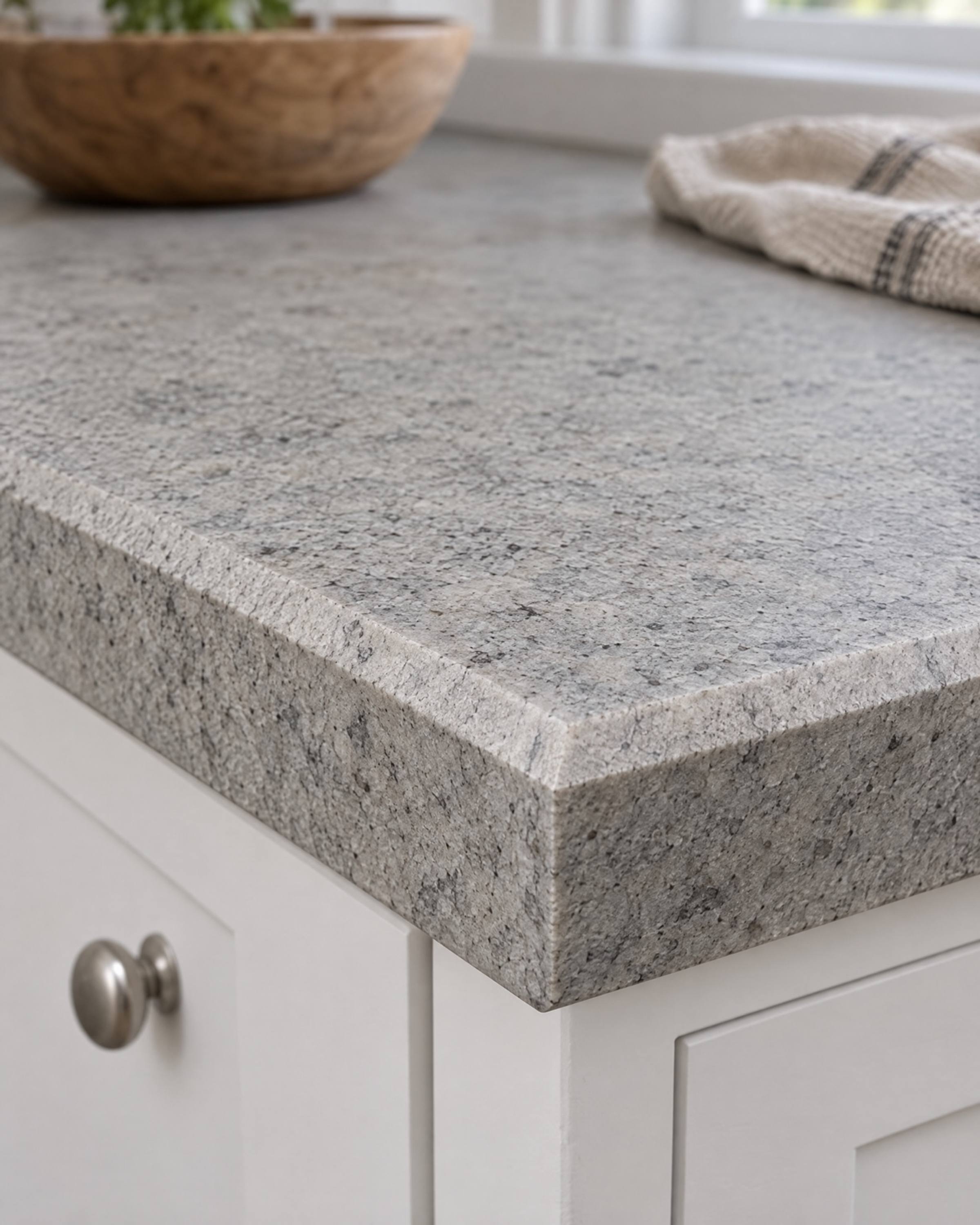
Bevel
- What it is
- The top corner cut at an angle, usually 45 degrees, leaving a narrow flat facet that catches the light.
- Suits
- Transitional and traditional kitchens; granite and quartzite, where the facet shows the stone's sparkle.
- Living with it
- Wipes clean, and the facet protects the corner from chipping.
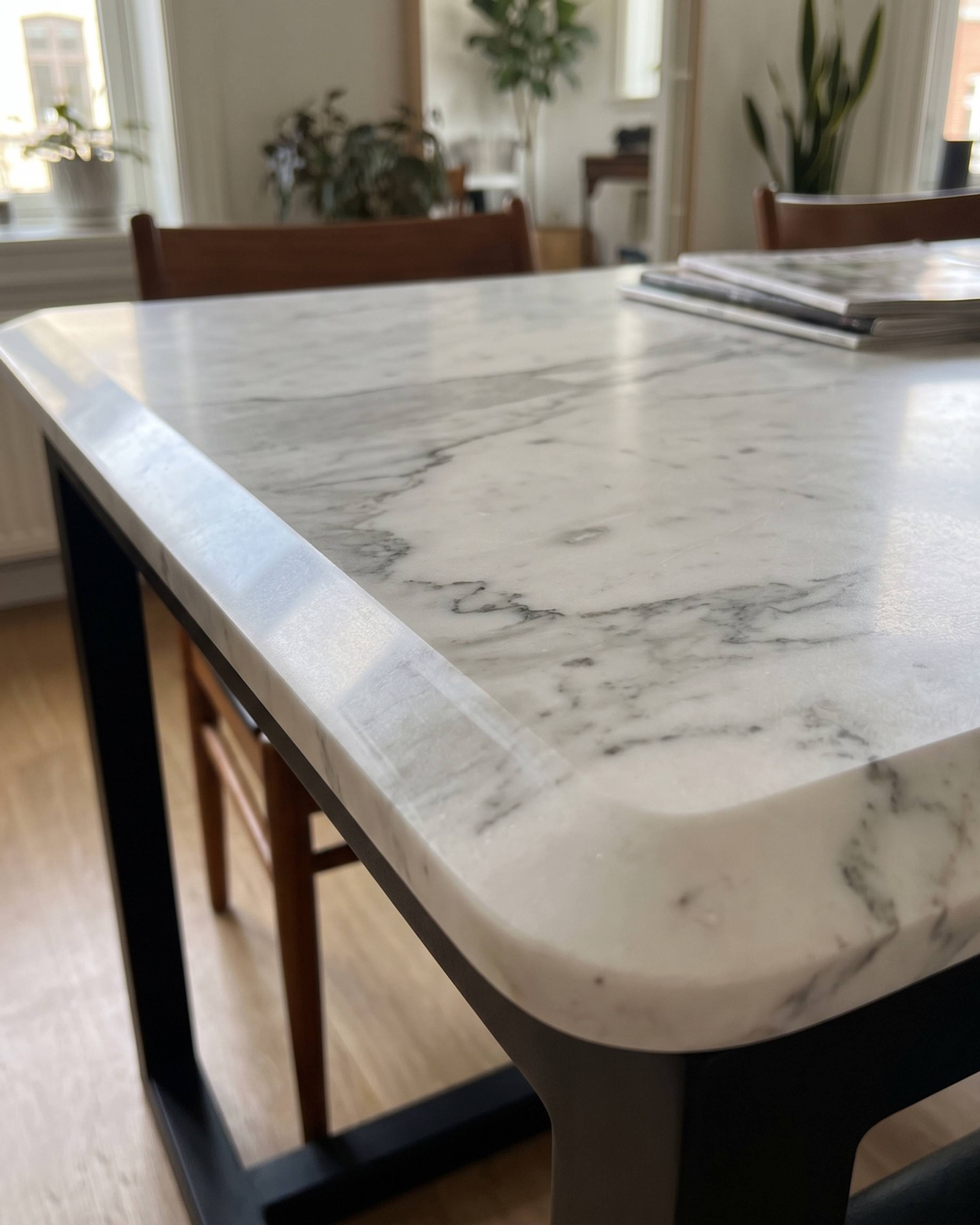
Hollywood bevel
- What it is
- A wide, shallow slope across the top of the edge, much broader than a standard bevel, so the surface seems to taper away.
- Suits
- Tables, desks and islands in polished stone, where the long slope reflects the light.
- Living with it
- Comfortable to lean on. A glass set right at the edge sits on a slope.
Moulded edgesCurves cut into the stone
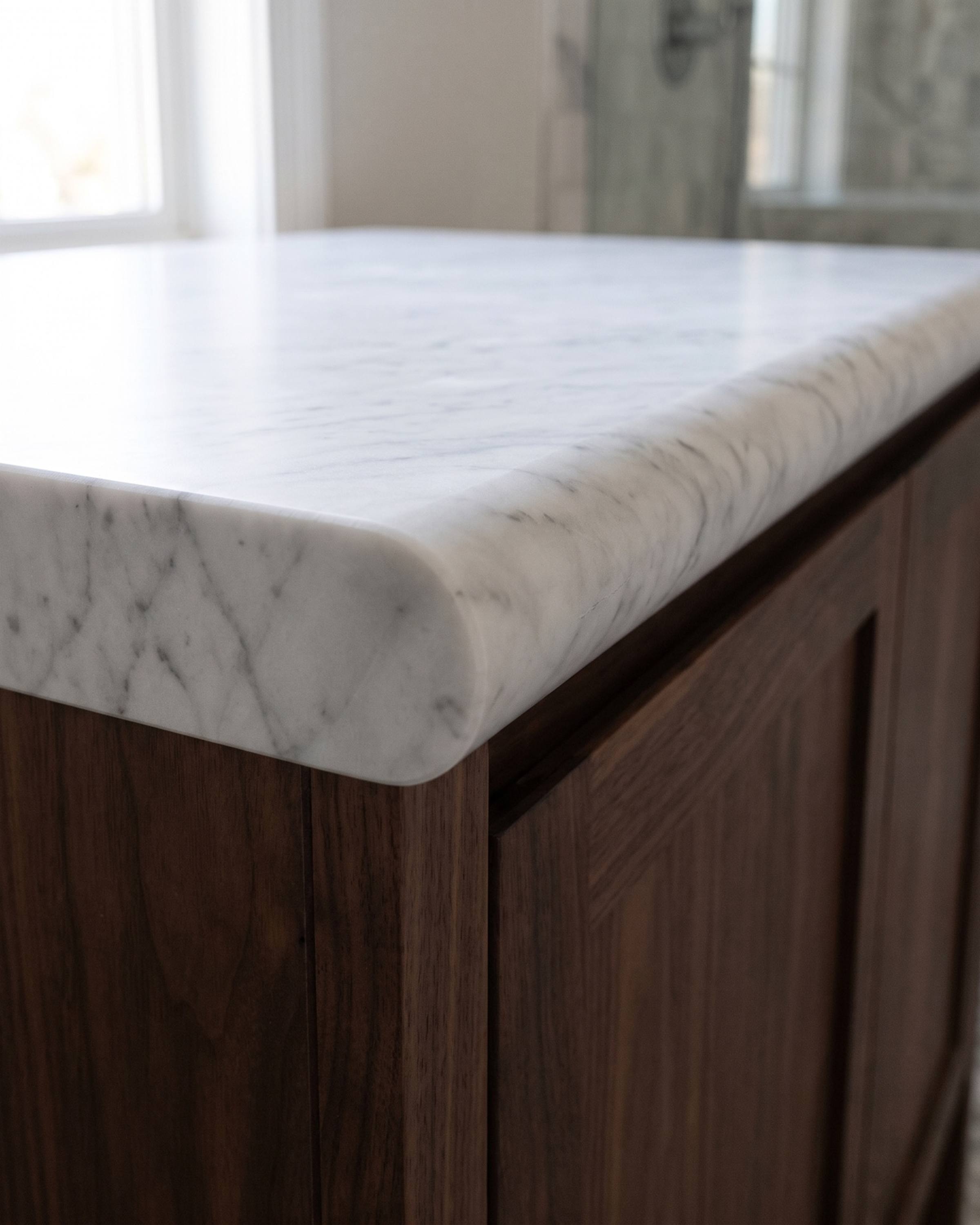
Full bullnose
- What it is
- The whole edge rounded into a half circle, top to bottom.
- Suits
- Traditional and family kitchens, bathrooms, anywhere children run at head height. Soft stones like marble.
- Living with it
- The most chip-resistant edge and the kindest to bump into. Spills can run around the curve and down the cabinet, so wipe promptly.
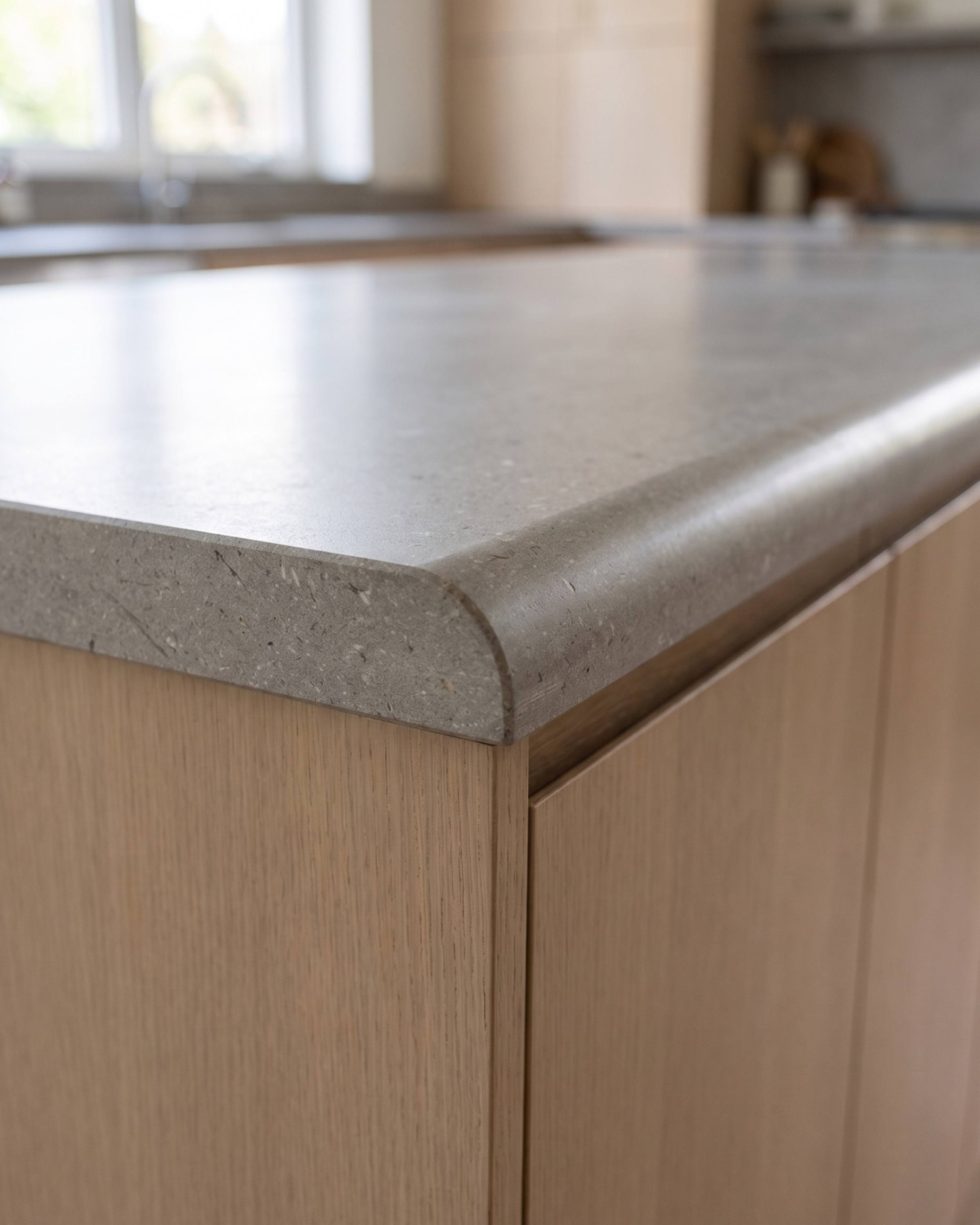
Half bullnose
- What it is
- Rounded on top and flat underneath: the top rolls over in one curve and meets the underside at a crisp corner. Also called a demi-bullnose.
- Suits
- Almost any kitchen or bathroom; the everyday rounded edge, softer than eased and plainer than a full bullnose.
- Living with it
- Comfortable to lean on and hard to chip. Spills drip clear of the cabinet doors instead of running back under the edge.
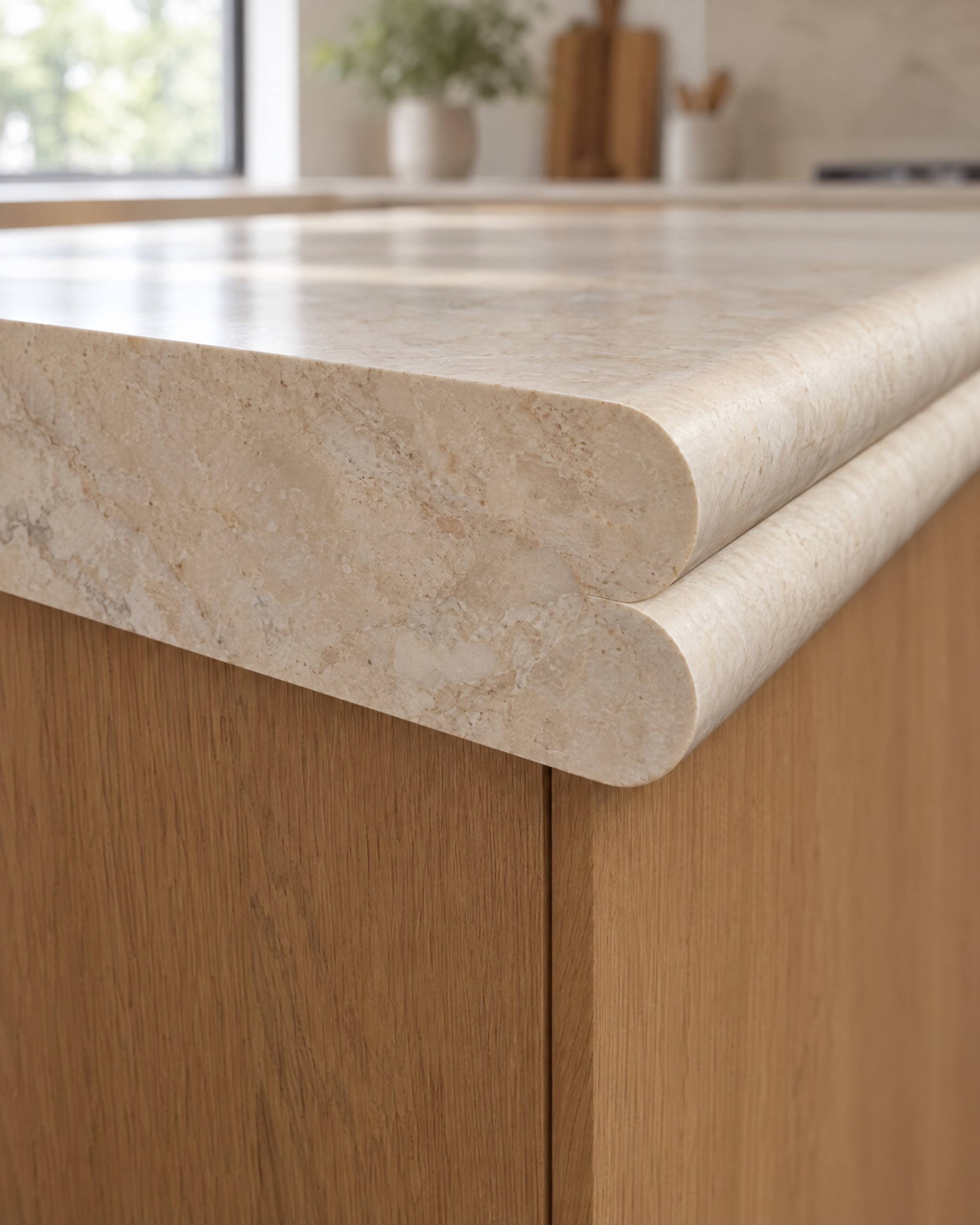
Double bullnose
- What it is
- Two rounded edges stacked, one above the other, usually from two layers of stone.
- Suits
- An island or a vanity that needs more presence without sharp lines.
- Living with it
- The seam between the two layers needs a careful fabricator, and the groove needs a wipe.
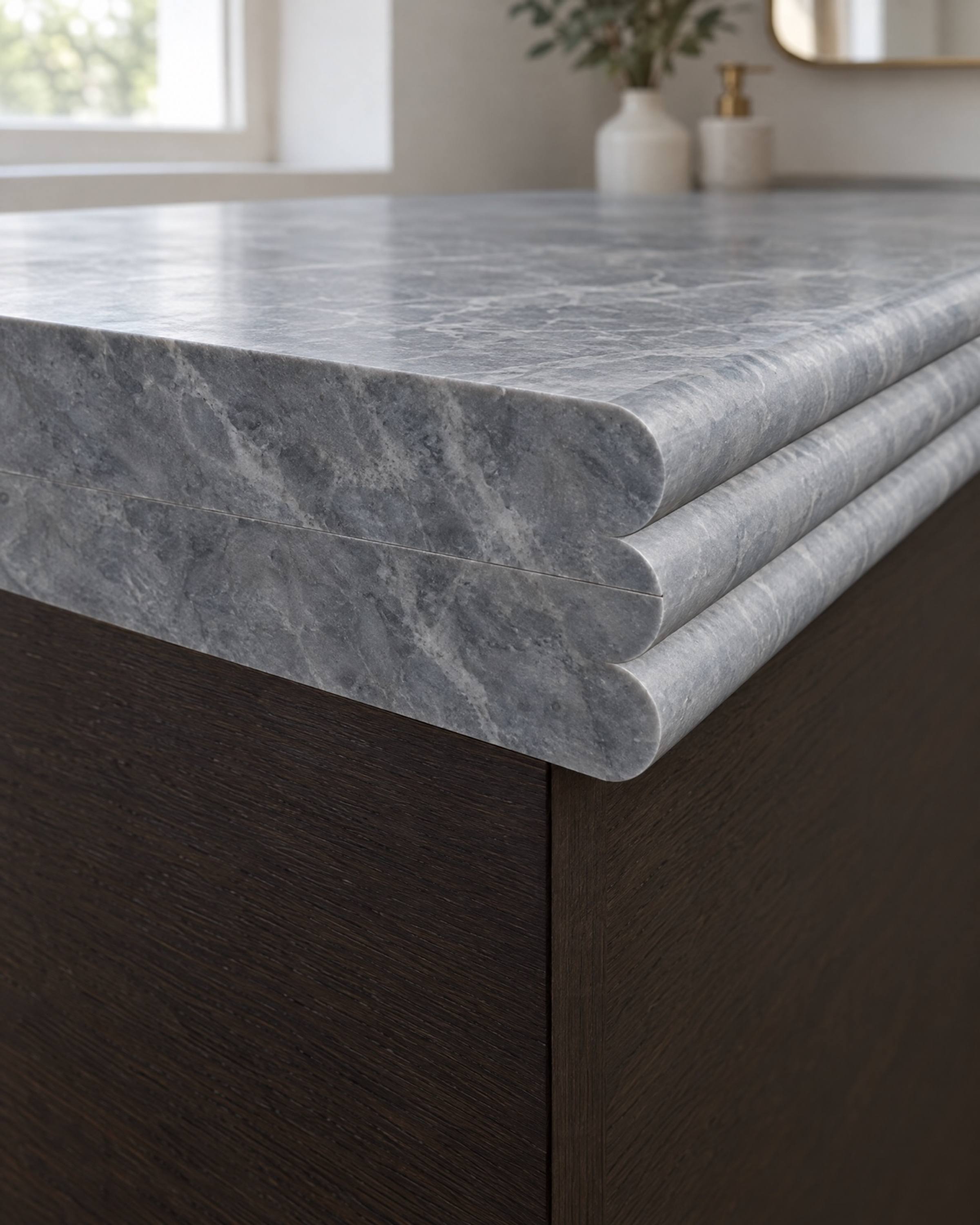
Triple bullnose
- What it is
- Three rounded layers stacked, like three smooth pebbles.
- Suits
- One piece meant to be noticed: a powder-room vanity, a bar, a small island. Honed stones, where the softness shows.
- Living with it
- Sculptural and heavy-looking. Use it once in a house, not everywhere.
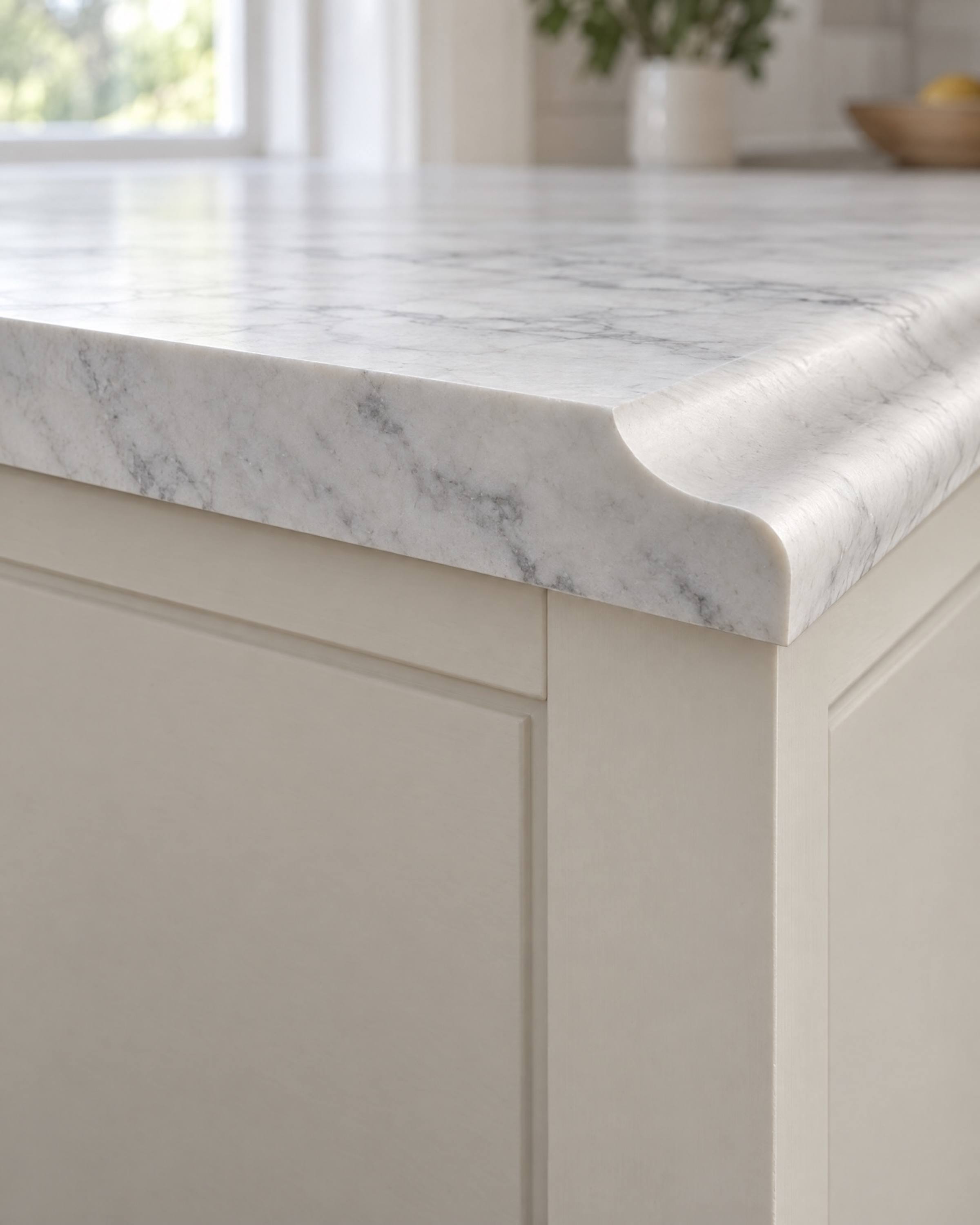
Ogee
- What it is
- An S-shaped curve: a shallow concave scoop at the top that rolls over into a convex curve, with a straight face below.
- Suits
- Classic, traditional kitchens and furniture-style islands; marble above all.
- Living with it
- The scoop holds crumbs, so expect to run a cloth along it. Needs a 3 cm slab or more to read well.
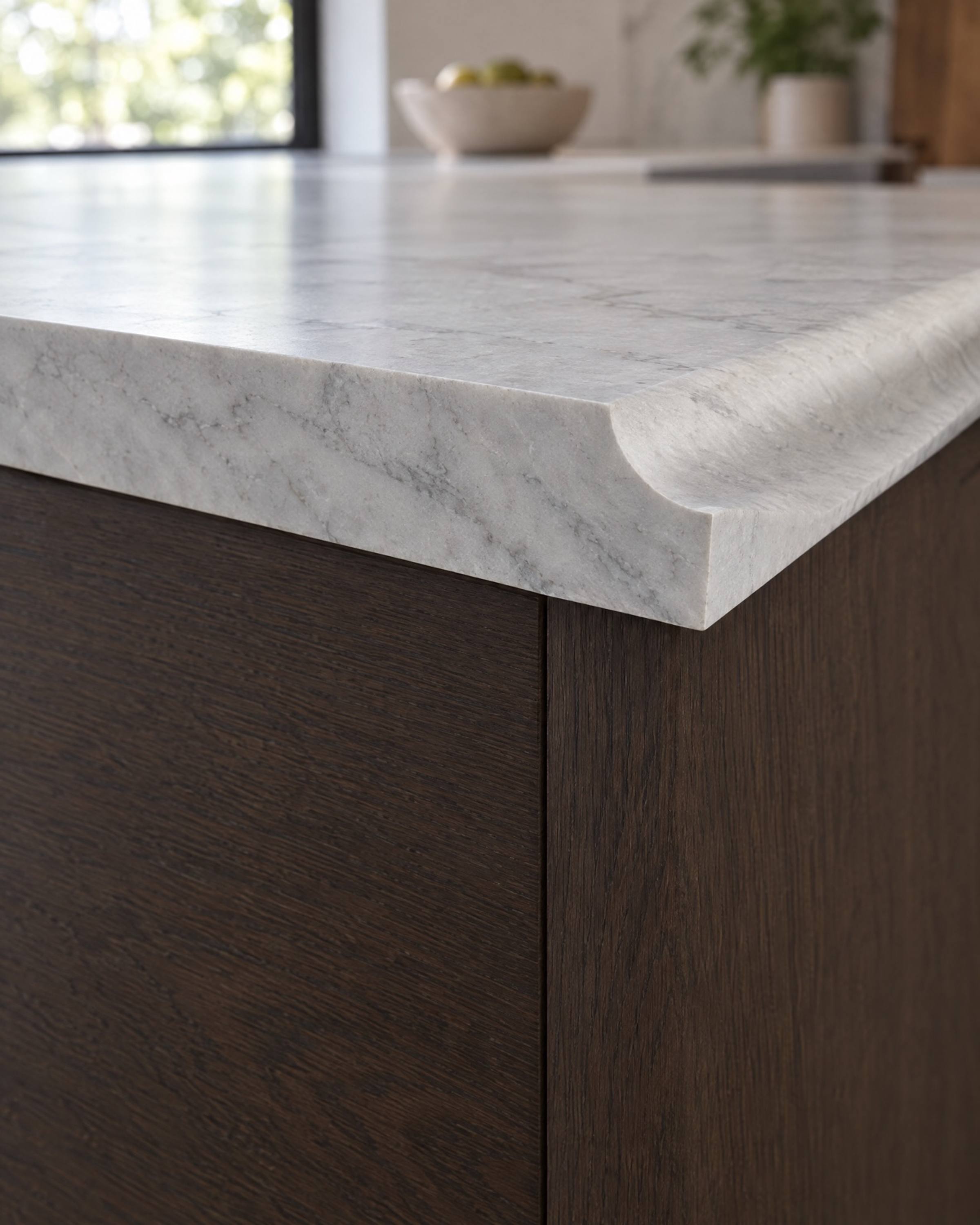
Cove
- What it is
- A concave scoop cut into the top corner, like the inside of a spoon, above a straight edge.
- Suits
- Traditional rooms that want a moulded edge quieter than an ogee; it pairs well with panelled cabinetry.
- Living with it
- The scoop catches the light and, like the ogee, a few crumbs.
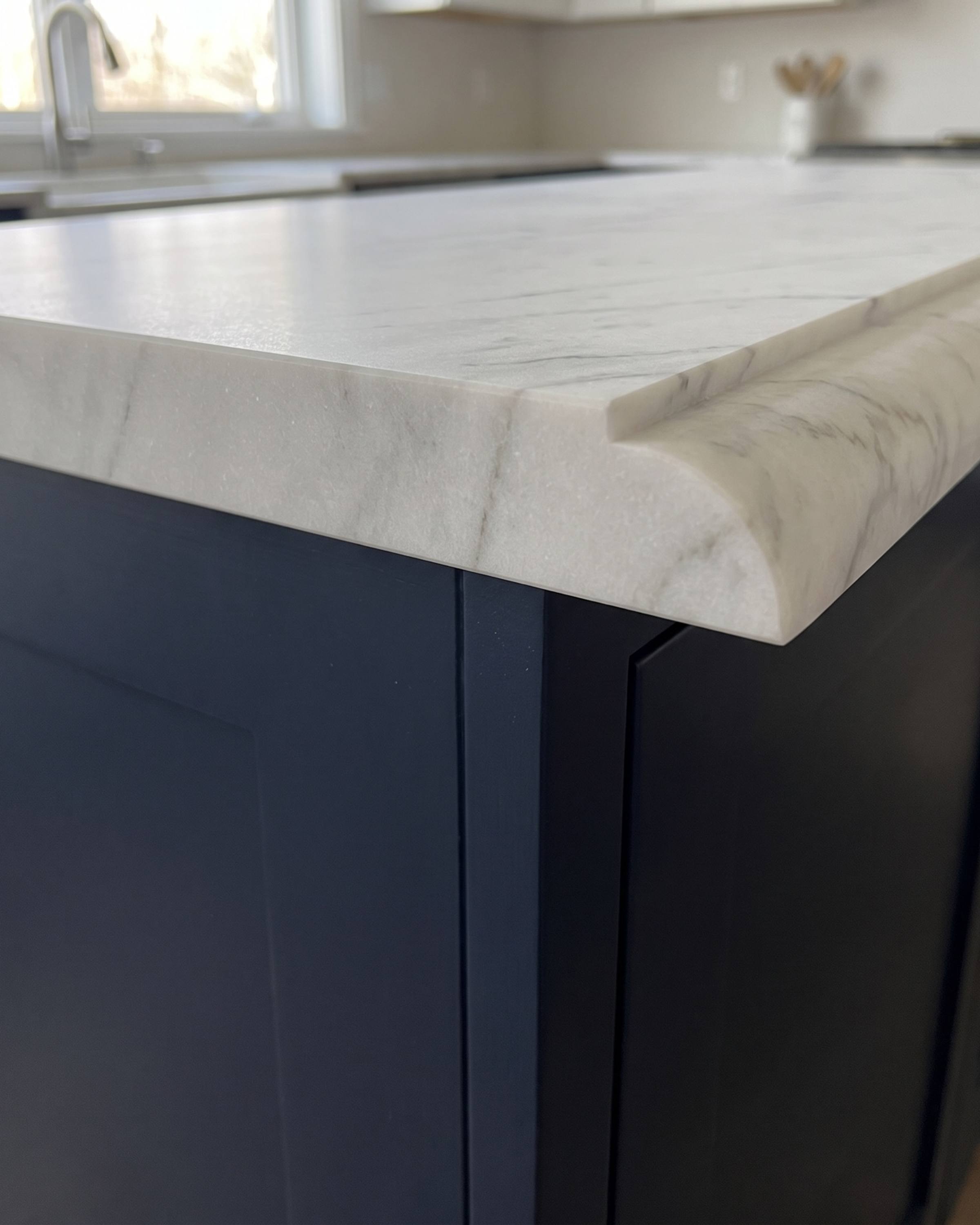
Dupont
- What it is
- A crisp square step down from the top, then one large quarter-round that runs out and down to the underside.
- Suits
- Formal, traditional kitchens, butler's pantries, bar tops and vanities. The most architectural of the classic profiles.
- Living with it
- The crisp step is the first place to chip on soft stone; harder stones hold it better.
Built-up edgesThicker than the slab
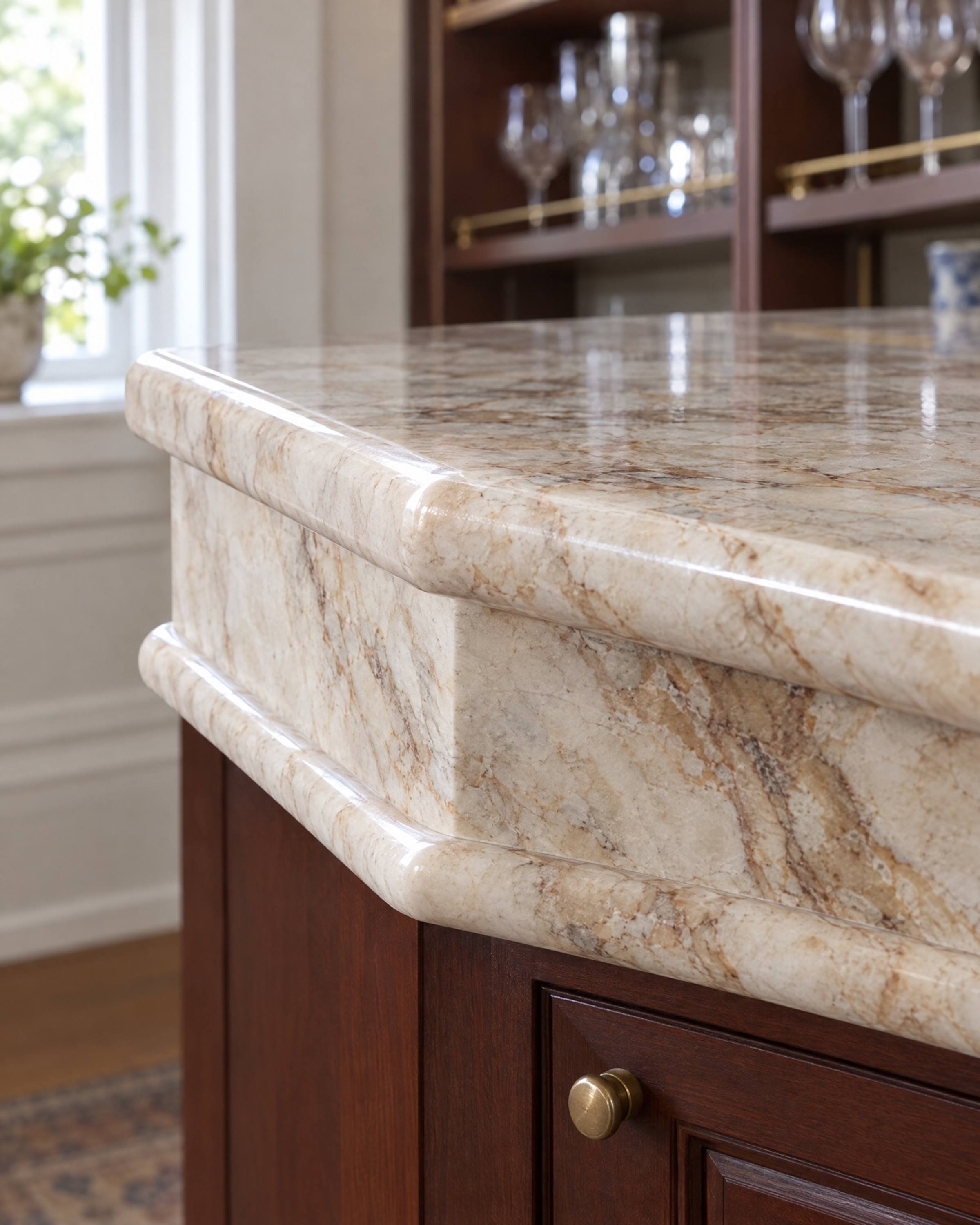
Laminated
- What it is
- A construction more than a shape: a second strip of stone glued under the edge to double its thickness, or a full apron with a rounded lip at the top and another at the base.
- Suits
- Traditional kitchens that want a deep, moulded edge.
- Living with it
- A fine horizontal seam shows if you look for it. How well the veins are matched makes the difference.
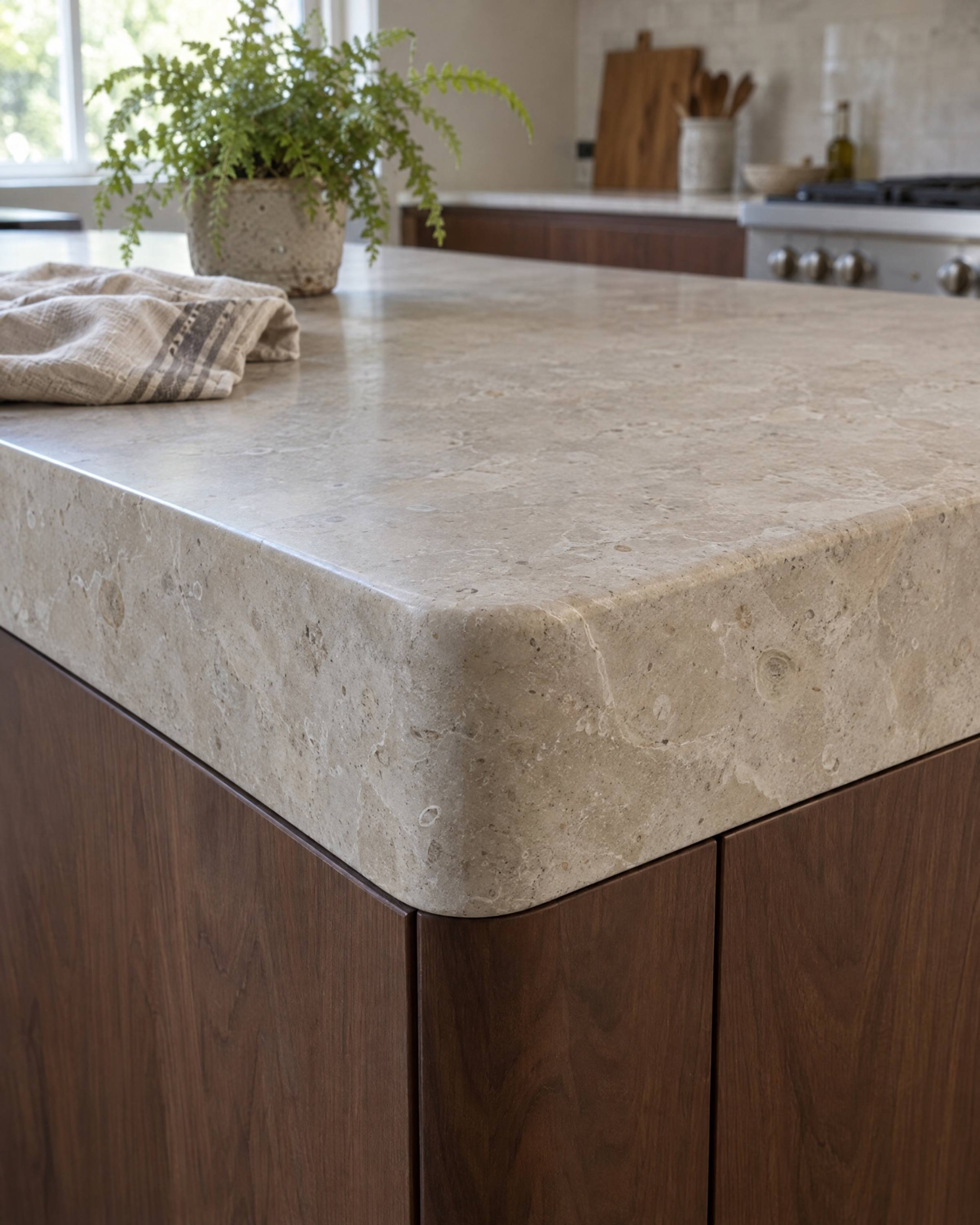
Mitered
- What it is
- The top and a vertical strip of the same slab cut at 45 degrees and joined, so the veining turns the corner and the counter looks like a solid block. A rounded miter, shown here, softens that corner into a curve.
- Suits
- Modern kitchens, floating vanities, travertine and heavily veined marble.
- Living with it
- A sharp mitered corner is the most fragile edge there is on soft stone. The rounded version solves that and feels better to the hand.
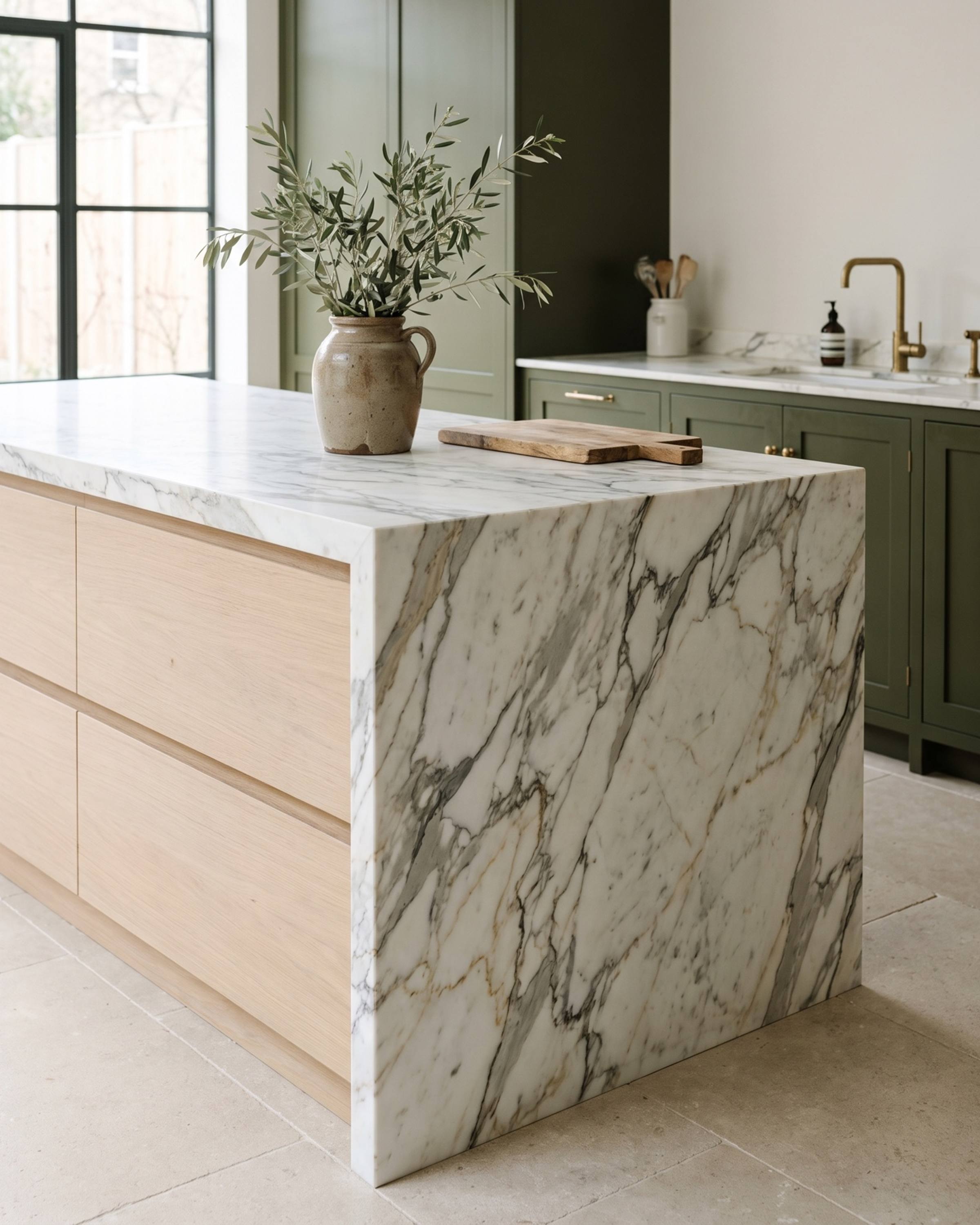
Waterfall
- What it is
- The countertop turns 90 degrees at the end of the island and continues down to the floor, the veining flowing over the corner.
- Suits
- Modern islands, especially where the end of the island faces the room. It needs a slab with veining worth following.
- Living with it
- Protects the end of the cabinetry from stools and shoes. Needs extra slab and a fabricator who matches the veins well.
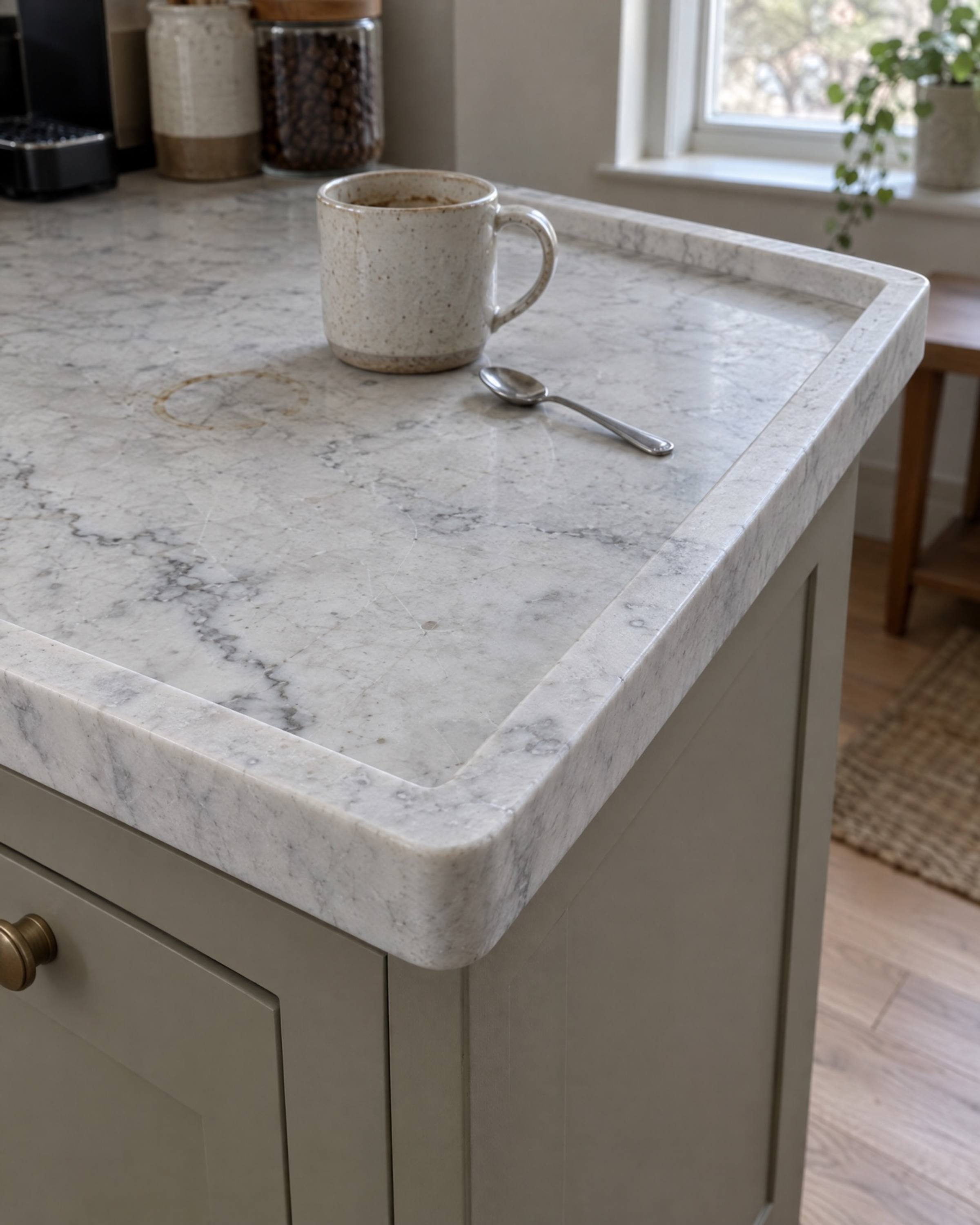
Tray
- What it is
- A raised lip around the perimeter, so the counter is a shallow tray. Also called a marine edge.
- Suits
- Bars, coffee stations, vanities and laundry counters, where it keeps spills and small things in.
- Living with it
- You can't sweep crumbs off the edge into your hand; they stop at the lip.
Carved edgesTexture along the edge
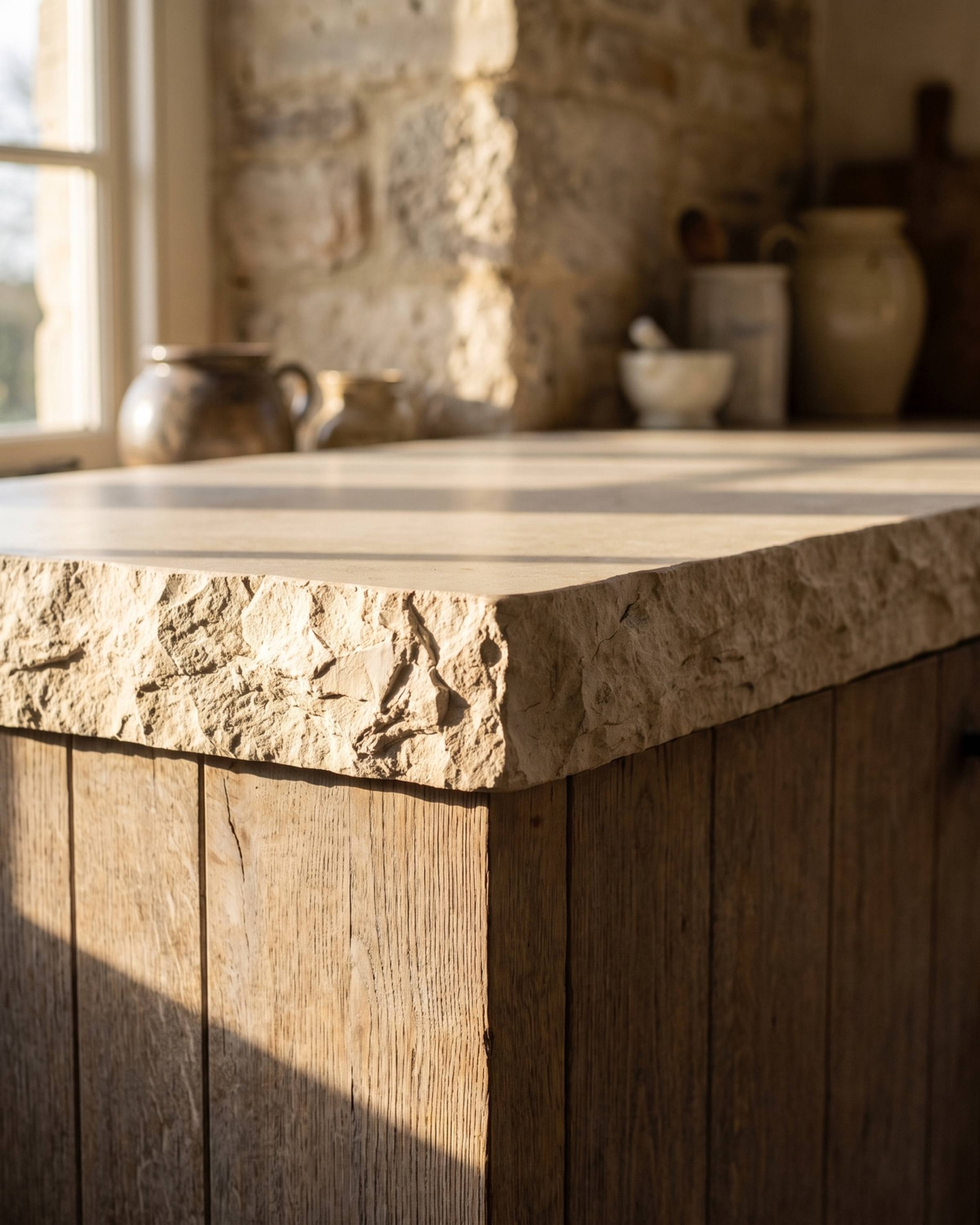
Chiseled
- What it is
- The edge broken by hand so it looks like raw, split rock.
- Suits
- Rustic and mountain houses, outdoor kitchens, a fireplace hearth; thick slabs of limestone, travertine or granite.
- Living with it
- Rough to lean on, and it catches cloths. Best away from where people sit.
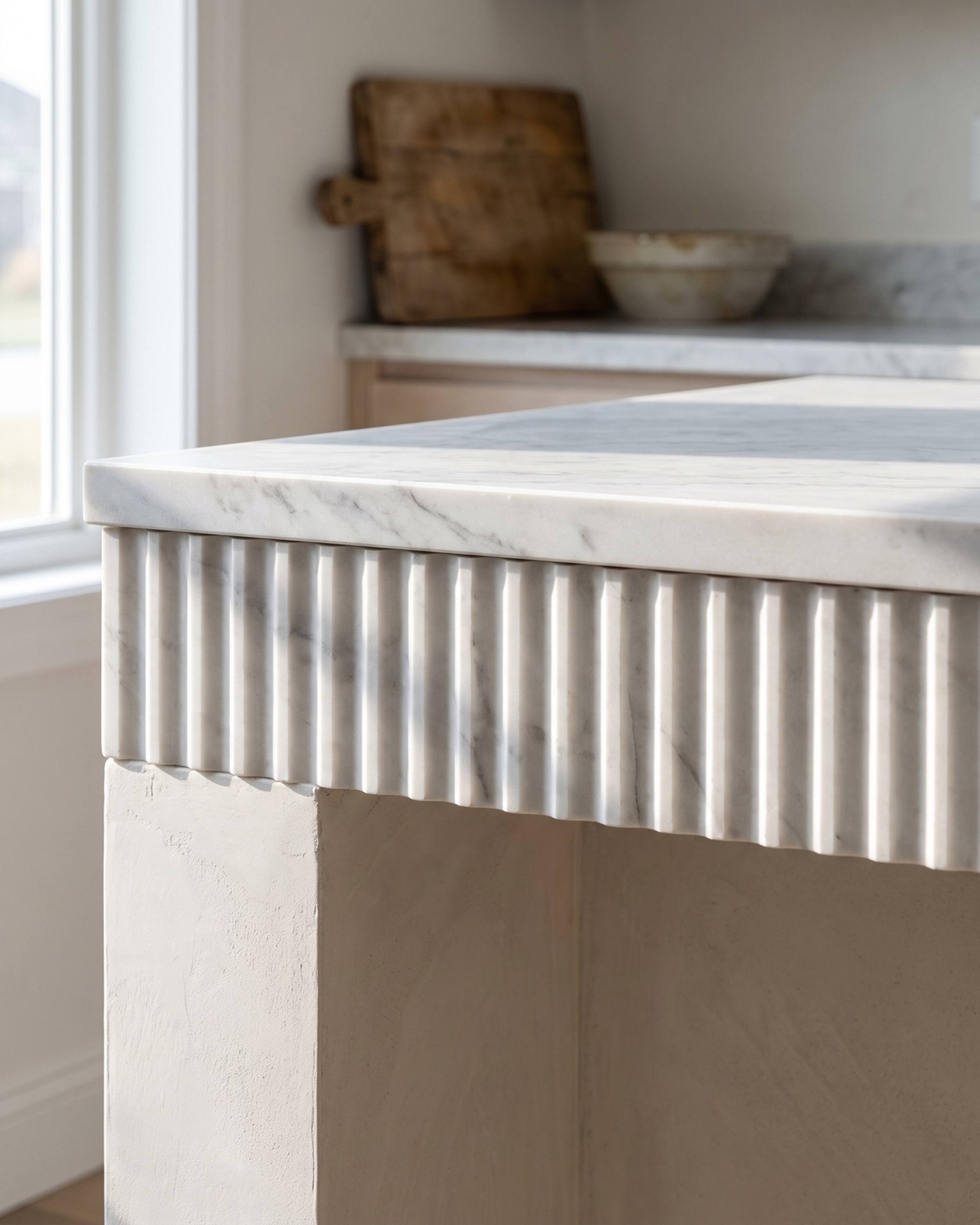
Fluted
- What it is
- A row of vertical concave grooves carved into the face of the edge or apron.
- Suits
- A deep mitered apron on an island or vanity; marble.
- Living with it
- The grooves gather dust and need a soft brush now and then. Cut by machine, so it needs a fabricator who has one.
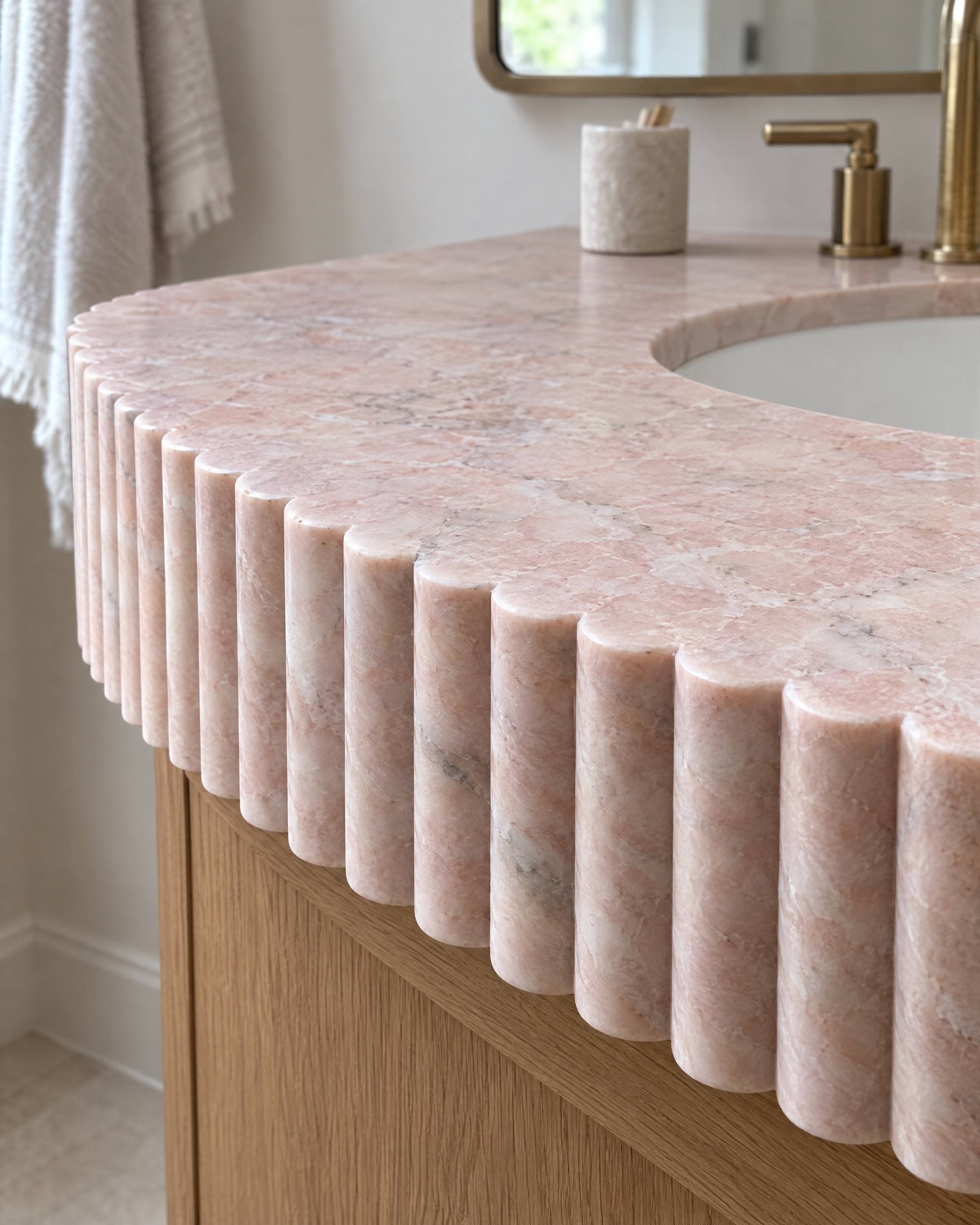
Reeded
- What it is
- The reverse of fluting: a row of vertical rounded ribs standing out from the edge.
- Suits
- The same places as fluting, with a softer, more furniture-like look. Lovely on a round or curved top.
- Living with it
- Like fluting, it gathers dust between the ribs and wants a soft brush.
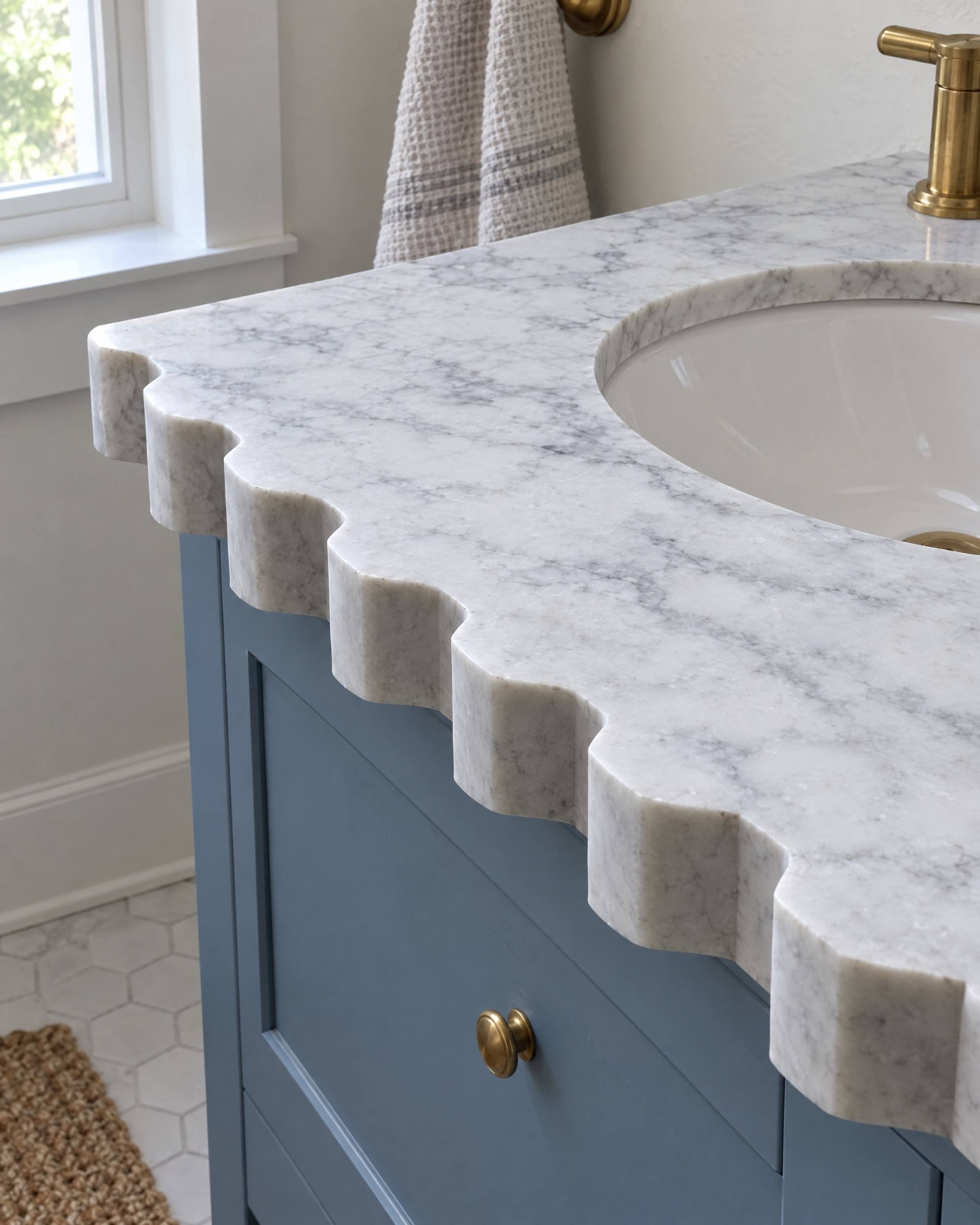
Scalloped
- What it is
- The outline of the counter cut into a repeating run of curves: half-round notches taken out of the edge or, in the other common version, rounded lobes like the edge of a shell.
- Suits
- A small, playful piece: a powder-room vanity, a bar shelf, the top of a backsplash. A little goes a long way.
- Living with it
- Every inside point is a place to chip and to clean.
How to choose
| If… | Consider… |
|---|---|
| You want it never to date | Eased or bevel |
| There are young children in the house | Full bullnose, half bullnose or a rounded miter |
| The kitchen is traditional or colonial | Ogee, cove or Dupont on the island; eased on the perimeter |
| The kitchen is modern | Eased, mitered or waterfall |
| The stone is soft (marble, limestone, travertine) | Rounded profiles; avoid sharp miters |
| The slab looks too thin | Mitered or laminated |
| You want one piece noticed | Fluted, reeded, scalloped or triple bullnose, on that piece only |
Two rules we work by. Mix no more than two profiles in a room: a quiet one on the perimeter, a richer one on the island. And choose the edge with the stone in front of you: the same ogee looks crisp in white marble and busy in a heavily patterned granite.
Common questions
What is the most popular countertop edge?
The eased edge: square, with the corners just softened. It suits almost every kitchen and is usually included in the fabrication price.
Which countertop edge is the most durable?
A full bullnose or any well-rounded edge. There is no sharp corner to chip.
What is the best edge for marble?
A rounded or eased profile. Sharp corners and sharp miters chip more easily on soft stone.
What is an ogee edge?
An S-shaped moulded profile, concave at the top and convex below, used in traditional kitchens.
What is a mitered edge?
Two pieces of the same slab joined at 45 degrees, so the counter looks like one thick, solid block and the veining turns the corner.
What is the difference between fluted and reeded?
Fluting is a row of grooves carved into the stone. Reeding is the reverse: a row of raised, rounded ribs.
Which edge is best for a small kitchen?
A simple one: eased, bevel or half bullnose. A thin, plain edge keeps the counter from looking heavy, and a rounded corner is kinder in a tight space. Save the moulded and built-up edges for a room with space to step back.
Do edge profiles cost extra?
Simple ones are usually included. Moulded, built-up and carved edges are priced per linear foot, on top of the stone.