Types of stone: 18 marbles, quartzites and limestones, and where each works
Marble etches, quartzite doesn't, and soapstone shrugs off both. Here are 18 stones, from Carrara and Calacatta Monet to Verde Alpi, quartzite, travertine and Ceppo, grouped by how each one behaves, with where it works and what it is like to live with.

Which stone can you live with, and where? It comes down to three things. The first is chemistry. Marble, limestone and travertine are calcium carbonate, so anything acidic (lemon, wine, vinegar, tomato) dissolves a dull spot in the surface. That mark is an etch, not a stain, and no sealer prevents it. Quartzite and granite are harder and don't etch; soapstone is so dense that almost nothing marks it chemically.
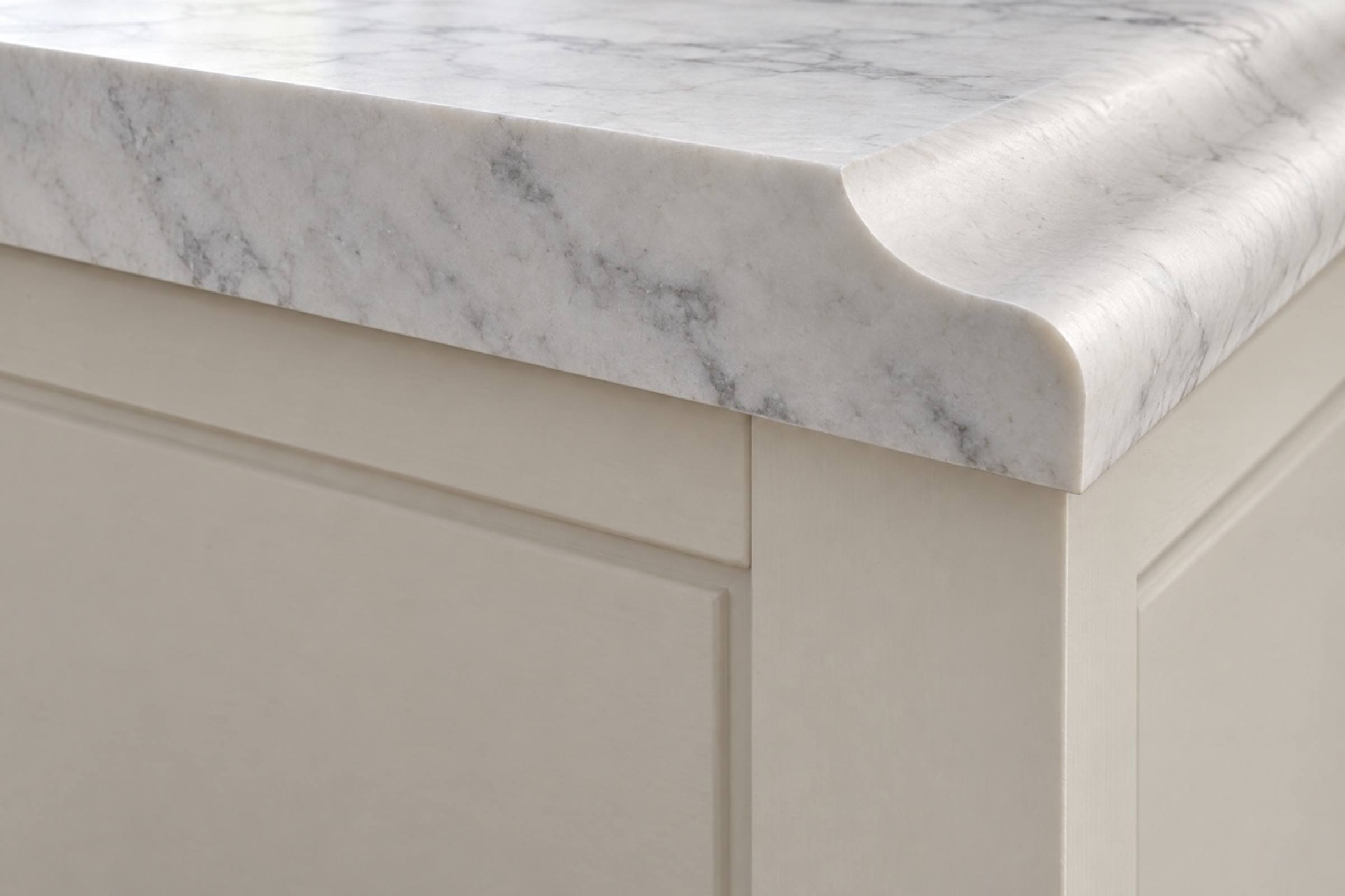
The second is porosity. Staining is a different problem from etching: it is liquid soaking in. An impregnating sealer slows it on marble, limestone, travertine and most quartzites, and soapstone needs none. The third is the finish. Polished stone is glossy and shows every etch; honed is matte, hides them, and is what we specify on nearly every pale marble; leathered has a soft texture and suits quartzite and darker stone.
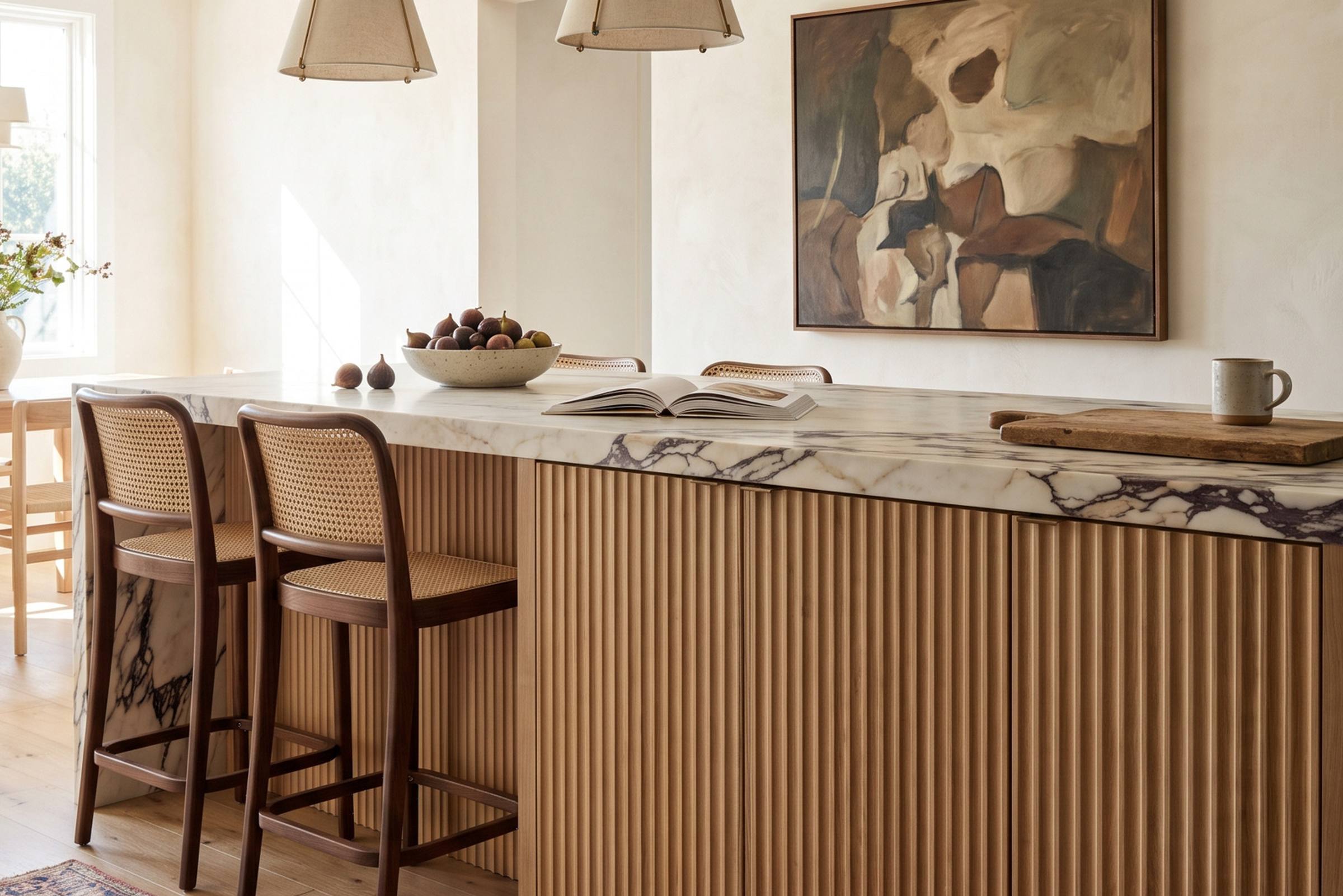
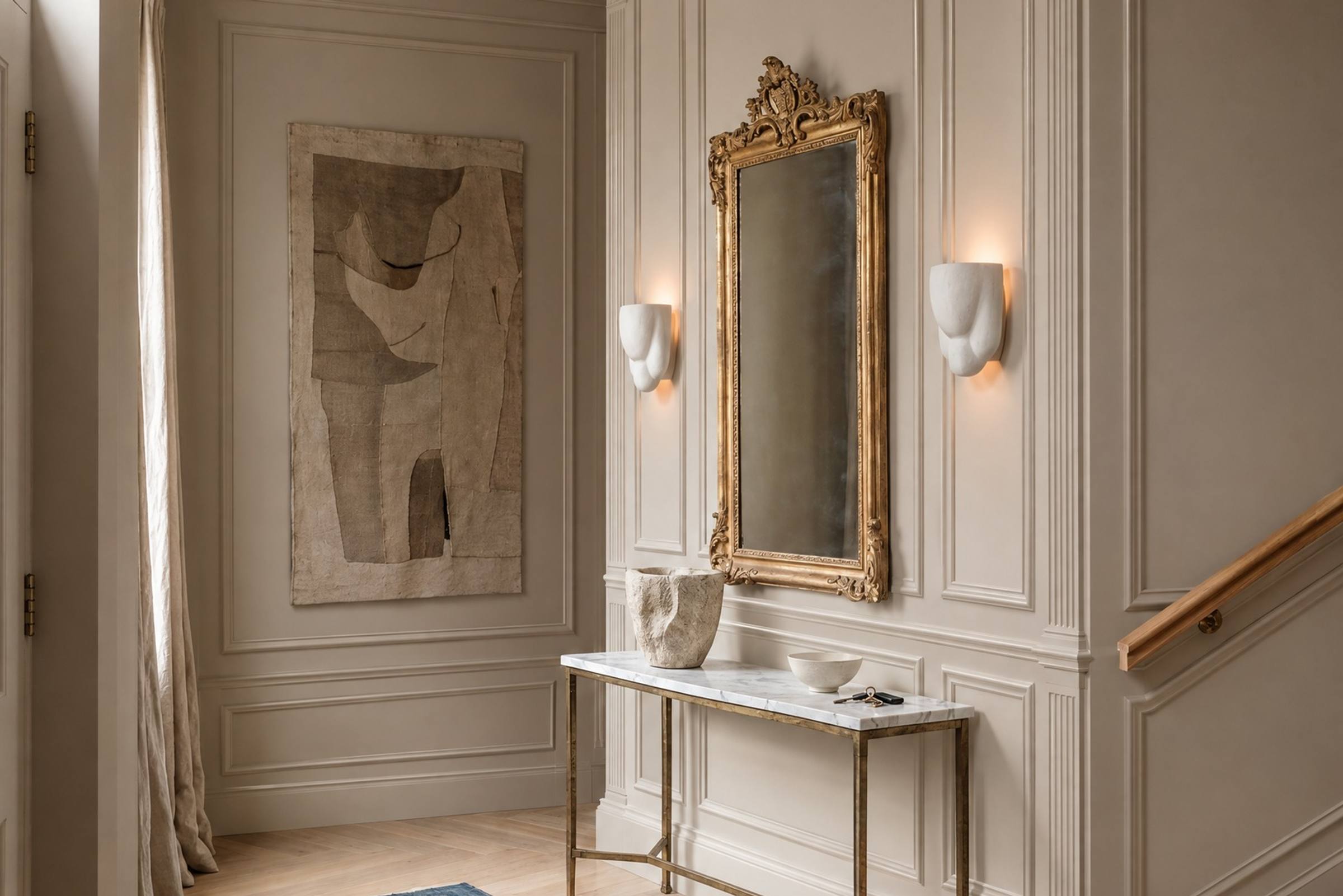
The guide is grouped by how the stone behaves, not by room: the two hard stones that don't etch, the white marbles, the coloured marbles, and the soft stones that run through a house as floors and walls. Each stone is shown where it works best, so a marble appears in a kitchen and a limestone in a hall. Cost is on a four-step scale, from $ to $$$$, relative to the other stones here; the figure moves with the slab, the yard and the fabrication, and nothing here is a quote.
In this guide
Hard stoneThe two that shrug off a lemon
Two stones take hard use without a conversation about patina: quartzite and soapstone. Both shrug off a lemon, so they go on the counter you cook on, a laundry, a mudroom, a bar that gets used. Our default for a family kitchen is a honed or leathered quartzite on the perimeter, and soapstone when the kitchen wants to be darker and softer. We skip granite in anything but black and honed. Quartz and porcelain are not here because they are not stone; a later guide, Countertop materials compared, sets them beside stone and wood.
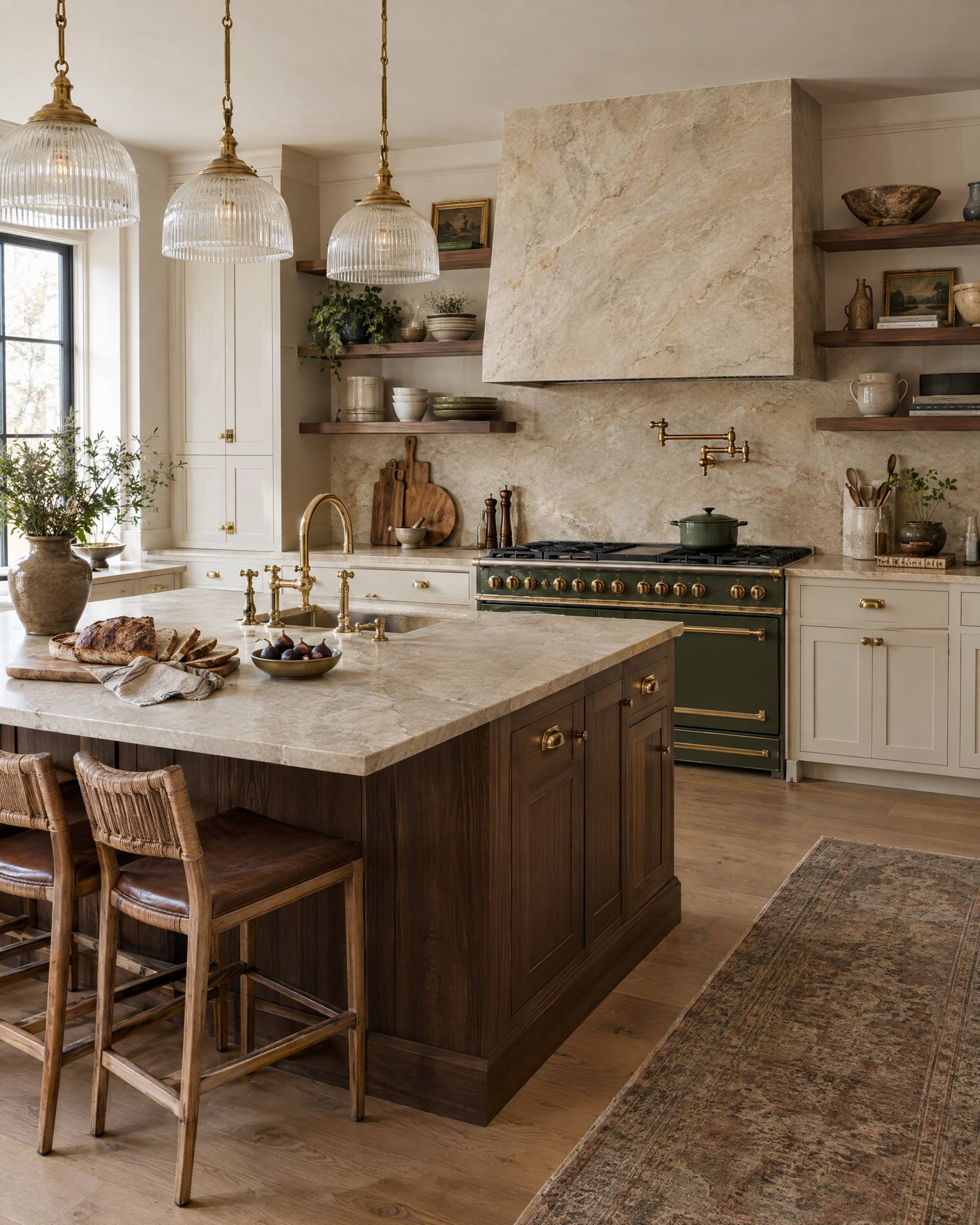
Quartzite
- What it is
- A metamorphosed sandstone, mostly from Brazil, much harder than marble and sold in slabs that look like it. Taj Mahal is cream with soft gold veins, the warmest; Perla Venata cream with fine linear veins; Mont Blanc white with grey and gold movement; Cristallo white and crystalline. Not quartz, a factory product.
- Where it works
- The everyday kitchen counter, the island, a backsplash, a vanity, a shower wall. The stone for people who want the look of Calacatta and a counter they can cook on. For a hard, dark, affordable counter, honed black granite does the same job with less movement.
- Living with it
- True quartzite does not etch; it can stain, so seal it once a year. Test a sample with lemon and a knife: some stone sold as quartzite is softer marble or dolomite. Harder to cut, so fabrication costs more, and thin overhangs can crack. A leathered finish suits it.
- Pairs with
- Cream or warm-white painted cabinets, or a walnut island under it. Aged brass. A range in olive green or cream. Paint: Benjamin Moore Swiss Coffee on the walls.
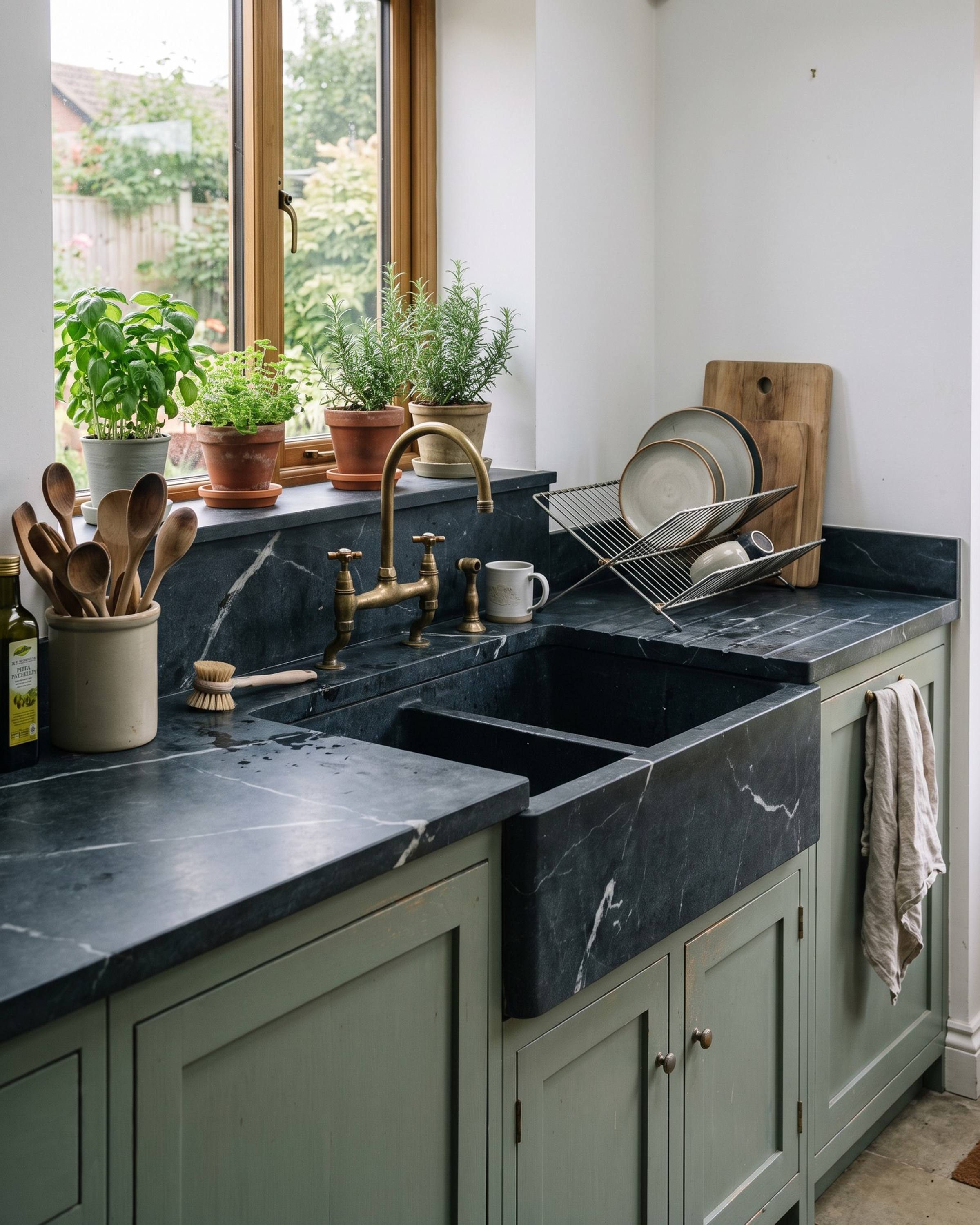
Soapstone
- What it is
- A dense talc stone from Brazil, Virginia and Vermont, grey-green when raw and charcoal when oiled, with milky quartz veins. Soft enough to scratch with a key, so dense that nothing soaks in. The stone of old laboratory counters and farmhouse sinks.
- Where it works
- A kitchen counter, a farmhouse sink, a hearth or a wood-stove surround, a laundry or pantry counter, a bathroom vanity. Best in a kitchen that is used. It suits painted cabinets and white or cream walls.
- Living with it
- No sealer, no etching, no stains, and hot pans go straight on it. It scratches and dents; a scratch is sanded out with fine paper and re-oiled. Oil or wax it every few months at first, then rarely; left dry it goes a lighter, uneven grey. Keep the edges eased or rounded.
- Pairs with
- Painted cabinets in sage, putty or warm white; white oak if you want wood. Unlacquered brass, which ages with it. Paint: Farrow & Ball Pigeon for the cabinets, a soft white above.
White marbleFive whites, with eyes open
The five white marbles people ask for. All of them etch, all of them stain without a sealer, and all of them are beautiful anywhere, including a kitchen, for someone who accepts that. Our rule for a kitchen: honed, an eased or rounded edge, sealed once a year, and the marble on the island or the baking counter rather than beside the sink and the range. If every mark will bother you, go back to the group above and choose a quartzite that looks like one of these.
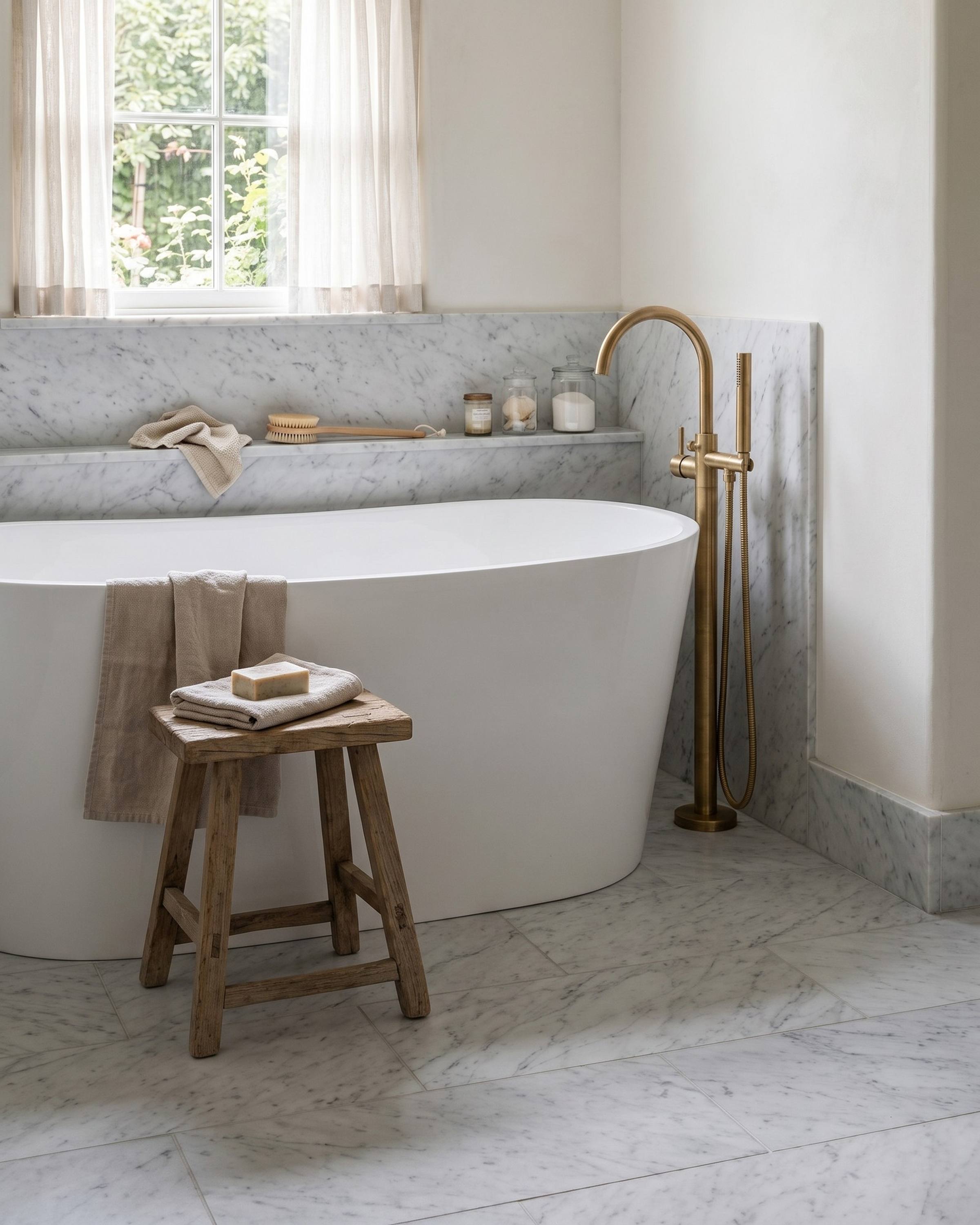
Carrara
- What it is
- The white marble from the quarries above Carrara, in Tuscany. A white to soft blue-grey ground with fine grey veining that feathers rather than streaks: the quietest of the whites and the most available. Grades vary a lot; some slabs are nearly clear, others clouded and grey.
- Where it works
- Bathrooms first: floors, walls, tub decks, a vanity top. Also a backsplash, a fireplace surround, and a kitchen counter for someone who wants the real thing and accepts marks. Buy it honed; polished Carrara shows every etch and reads dated.
- Living with it
- It etches with lemon, wine and vinegar and stains without a sealer, so seal it yearly. Honed, the etches blend into the stone within months. It chips at sharp edges, so choose an eased or rounded profile. It ages well if you let it.
- Pairs with
- White oak, or cabinets painted a warm white. Polished nickel in a bath, unlacquered brass in a kitchen. Paint: Benjamin Moore White Dove; it keeps Carrara's grey from turning cold.
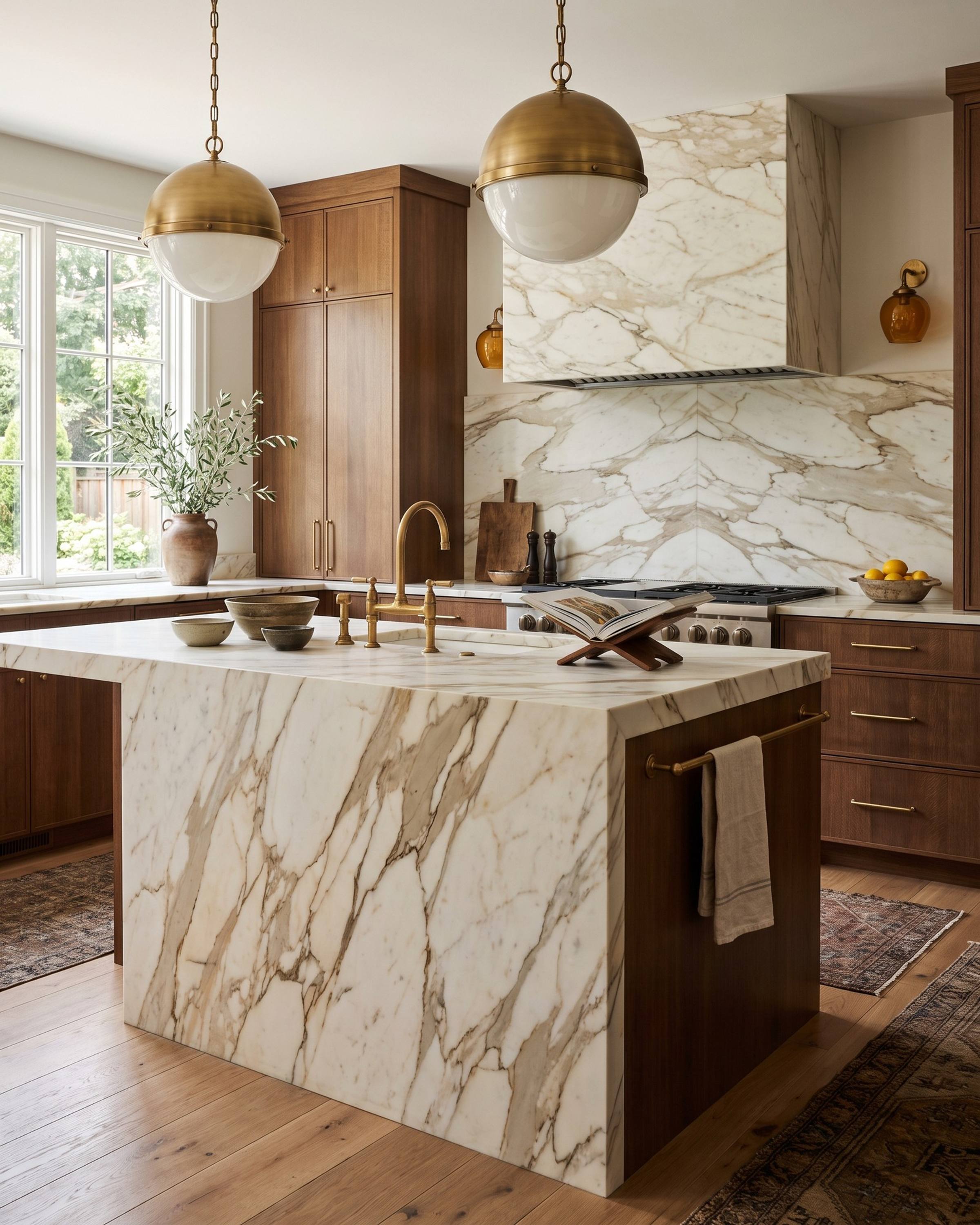
Calacatta Gold
- What it is
- A rarer marble from the same Apuan mountains as Carrara. A warm white to cream ground with thick, bold veins in gold, taupe and soft grey, far fewer and larger than Carrara's. The warmest of the classic whites.
- Where it works
- An island, a backsplash run behind the range, a vanity and backsplash cut from one slab, a fireplace: anywhere one slab is seen whole. Choose the slab in person; the vein pattern is the whole point and no two are alike.
- Living with it
- As much a marble as Carrara: it etches, stains and needs sealing. On an island with a family it will develop a patina; many clients like that, some don't. Honed is kinder. Expect to pay for the slab, then for a fabricator who lays out the veins with care.
- Pairs with
- Walnut, or cream cabinets with a walnut island. Unlacquered brass dome pendants and a bridge faucet. Amber glass sconces. Paint: Farrow & Ball Slipper Satin.
Calacatta Monet
- What it is
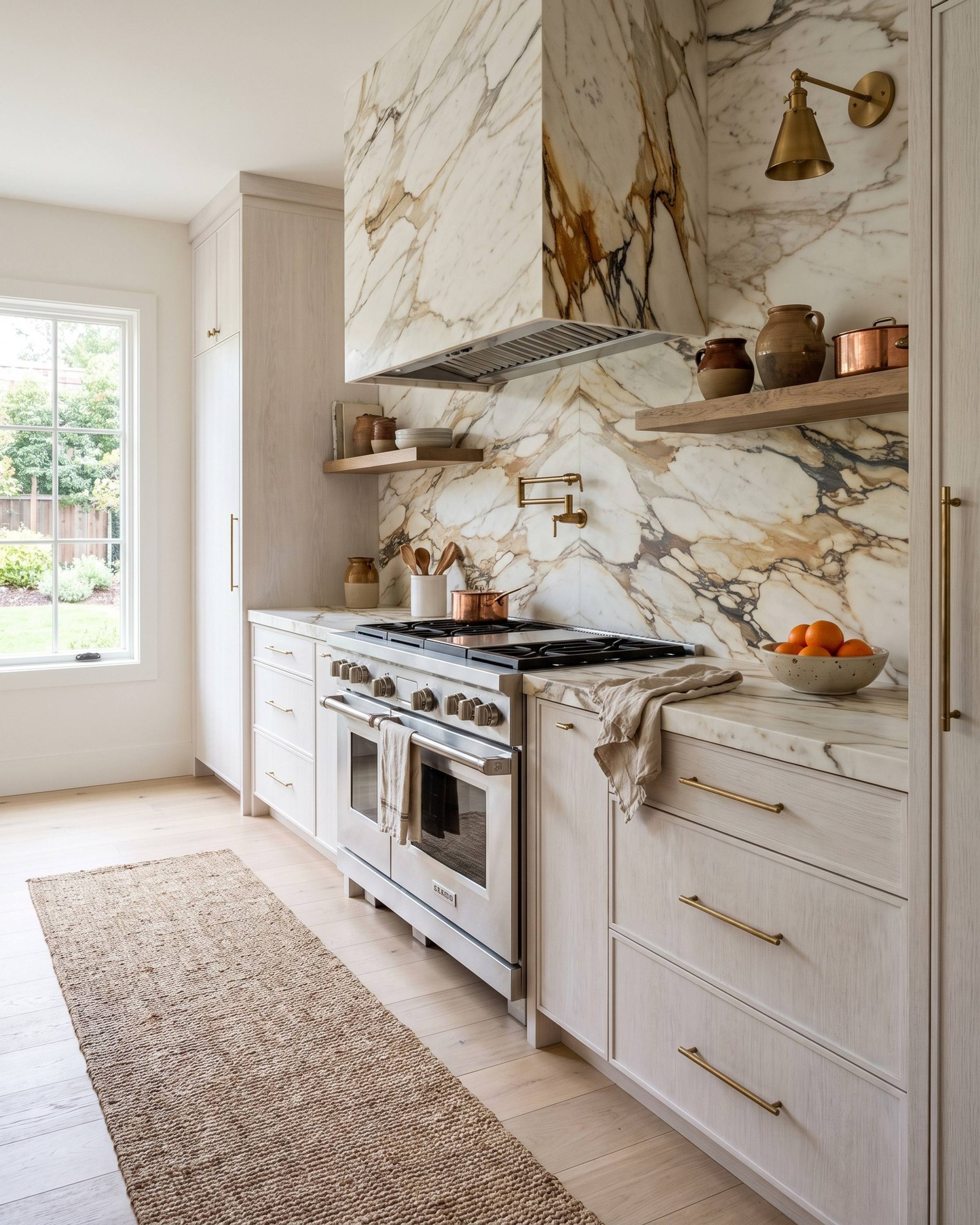
- The boldest of the Calacattas: a cream-white ground with thick veins in rust-gold, amber and charcoal that branch and pool across the slab. Italian, from the Apuan quarries, and the marble designers are naming most in 2026. Slabs differ a lot; some lean gold, some nearly black.
- Where it works
- A range wall with the backsplash, hood and counters in one run; an island; a fireplace; a bar. It is a whole composition, so keep the cabinetry plain: white-washed oak, cream, or walnut.
- Living with it
- A marble like Calacatta Gold: etches, stains, sealed yearly, honed to hide the marks. The dark veins hide etching better than the whites do; the cream ground does not. Choose the slab and plan the seams with the fabricator before anything is cut.
- Pairs with
- White-washed or rift-sawn oak, flat panels, nothing fussy. Aged brass. Paint: Farrow & Ball School House White, so the walls disappear behind the stone.
Statuario
- What it is
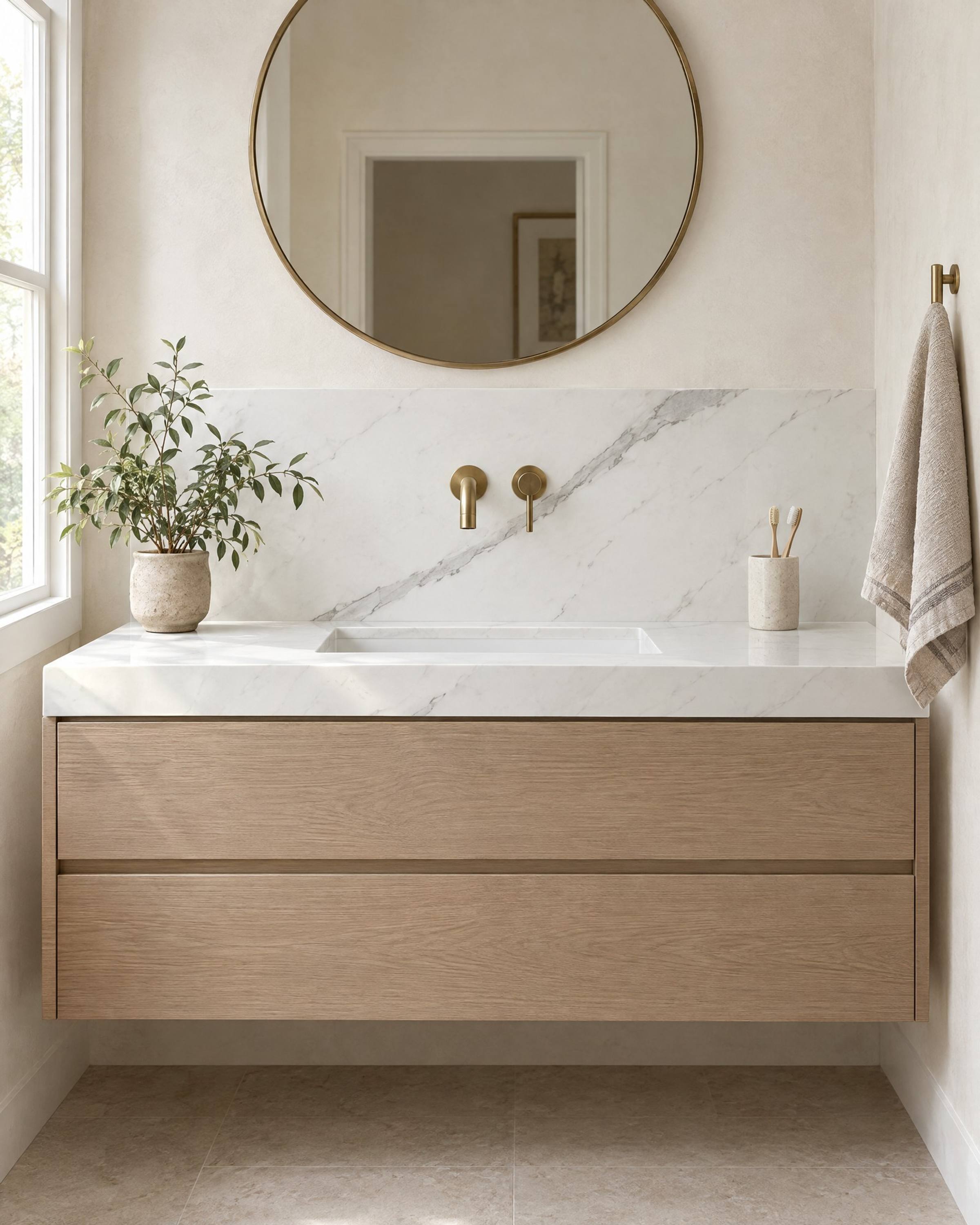
- The brightest of the Italian whites, also from the Apuan Alps. A clear white ground with sparse, decisive grey veins, sometimes a single sweep across the slab. Whiter and cleaner than Carrara, cooler than Calacatta Gold. Scarce, and widely imitated.
- Where it works
- One hero surface: a slab shower, a vanity with a slab backsplash, a fireplace, an island in a kitchen that is kept more than cooked in. Floors only in a low-traffic room. Insist on seeing the full slab; lesser stone is often sold under the name.
- Living with it
- The same chemistry as every white marble: it etches, stains and scratches, and the bright ground shows marks more than a cream one. Polished is its classic finish and the one most clients want; honed is more forgiving. Expensive to buy and to fabricate well.
- Pairs with
- Pale oak or lacquered white. Polished nickel or brass, one or the other. Paint: Benjamin Moore Chantilly Lace, the one white that is as bright as the stone.
Arabescato Corchia Max
- What it is
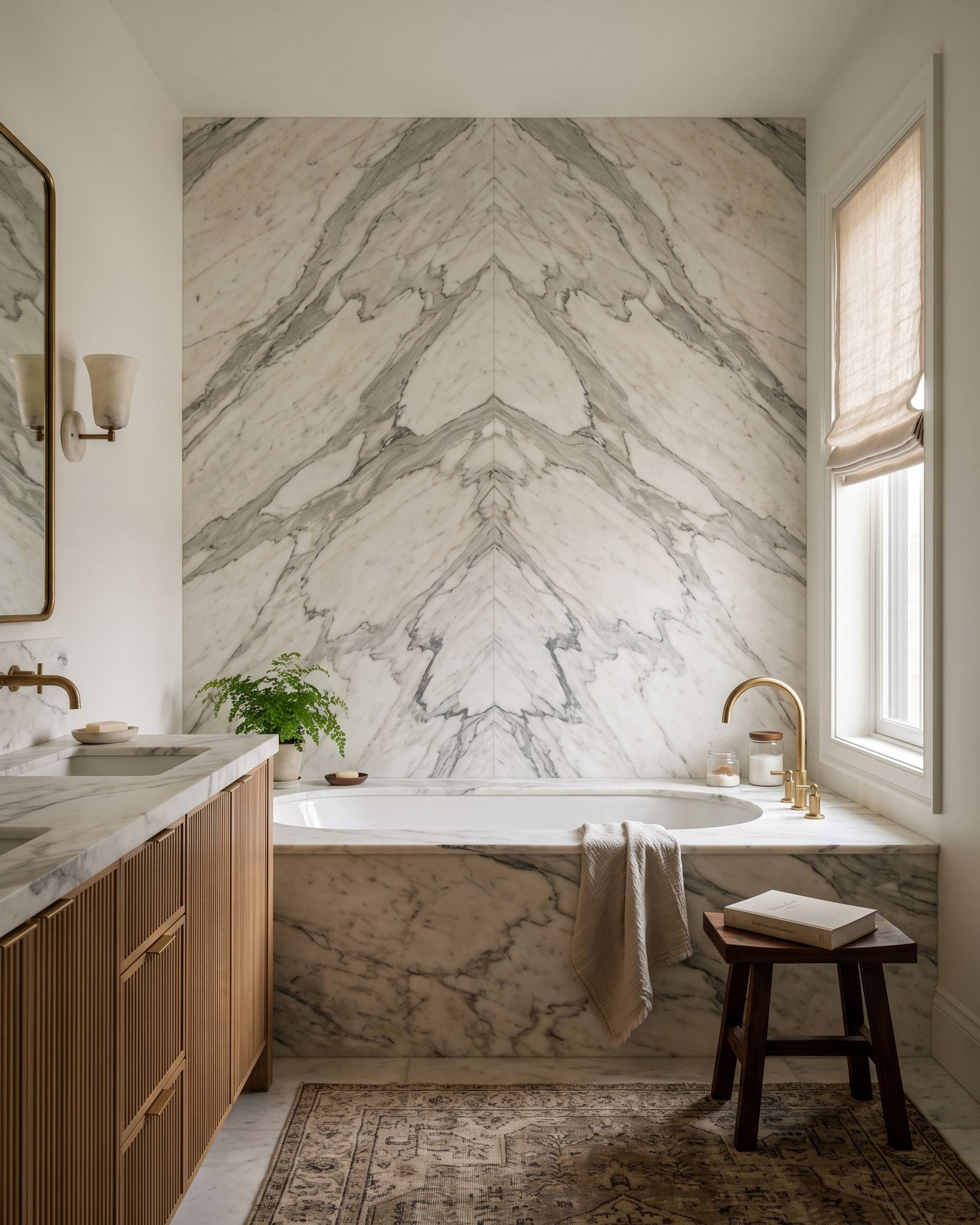
- Arabescato from the Corchia quarries above Seravezza in the Apuan Alps, in the trade's large-pattern grade: a warm white ground with big grey veins that loop and swirl in open shapes, more drawing than streak. The one grey-veined marble in this guide, kept because the pattern is so strong.
- Where it works
- A bathroom in slab: walls, tub deck, vanity. An island or a range wall with cream or oak cabinets. A fireplace. It needs a warm room around it (oak, brass, cream, linen) or it reads cold.
- Living with it
- Marble: etches, stains, sealed, honed. The pattern is the risk; mediocre slabs read busy or grey, so buy from the full slab and reserve them in sequence. Expensive, and more so bookmatched.
- Pairs with
- Cream painted cabinets or fluted white oak. Unlacquered brass. Paint: Farrow & Ball Pointing, warm enough to take the grey out of the veins.
Coloured marbleOne statement, seen whole
Colour is used once in a house: a fireplace, a bar, a powder room, a table. Seven stones that carry a room on their own, with quieter stone and plain wood around them. Honed on all but the two black marbles and the burgundy, which are defined by their polish. A later guide, Types of marble, takes twelve marbles one by one, with the grades and finishes to ask for.
Calacatta Viola
- What it is
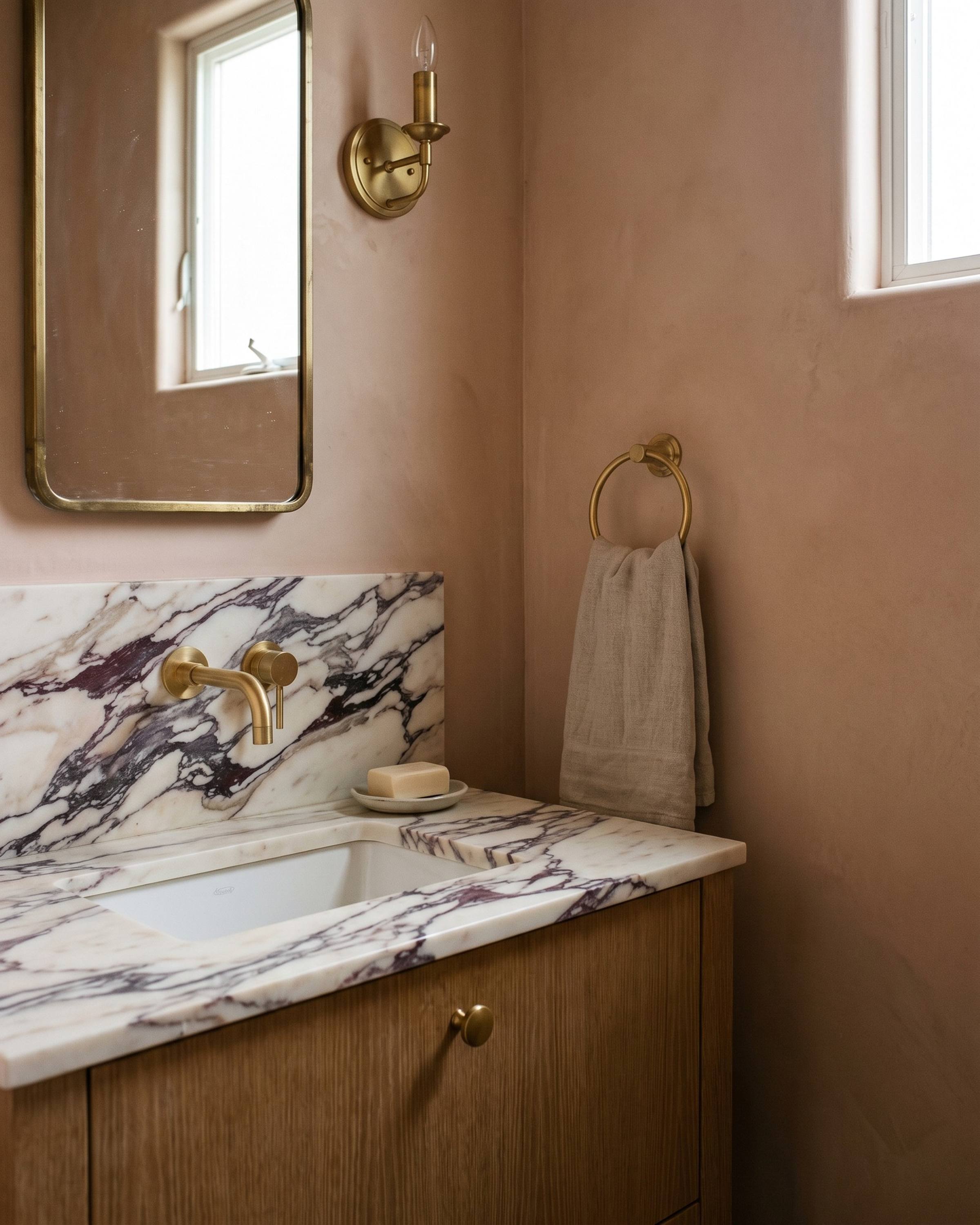
- An Italian marble from the Carrara district with a cream to white ground and veins in burgundy, plum and violet-grey, often with a taupe halo. Slabs range from mostly grey-violet to strongly purple-red, so a photograph is not enough; pick the slab.
- Where it works
- A powder-room vanity and backsplash, a fireplace surround, a bar front, a coffee or side table: one piece, seen whole. Not a family kitchen counter; the pale ground etches and the veins are the point.
- Living with it
- Etches and stains like any marble, so seal it and wipe spills. Honed suits it and keeps it from looking glossy. Fabricators cut it like Calacatta; the cost is in the slab, and good slabs sell fast.
- Pairs with
- Rift-sawn oak. Aged brass. Walls in a clay-pink plaster or Farrow & Ball Setting Plaster, which picks up the veins without competing.
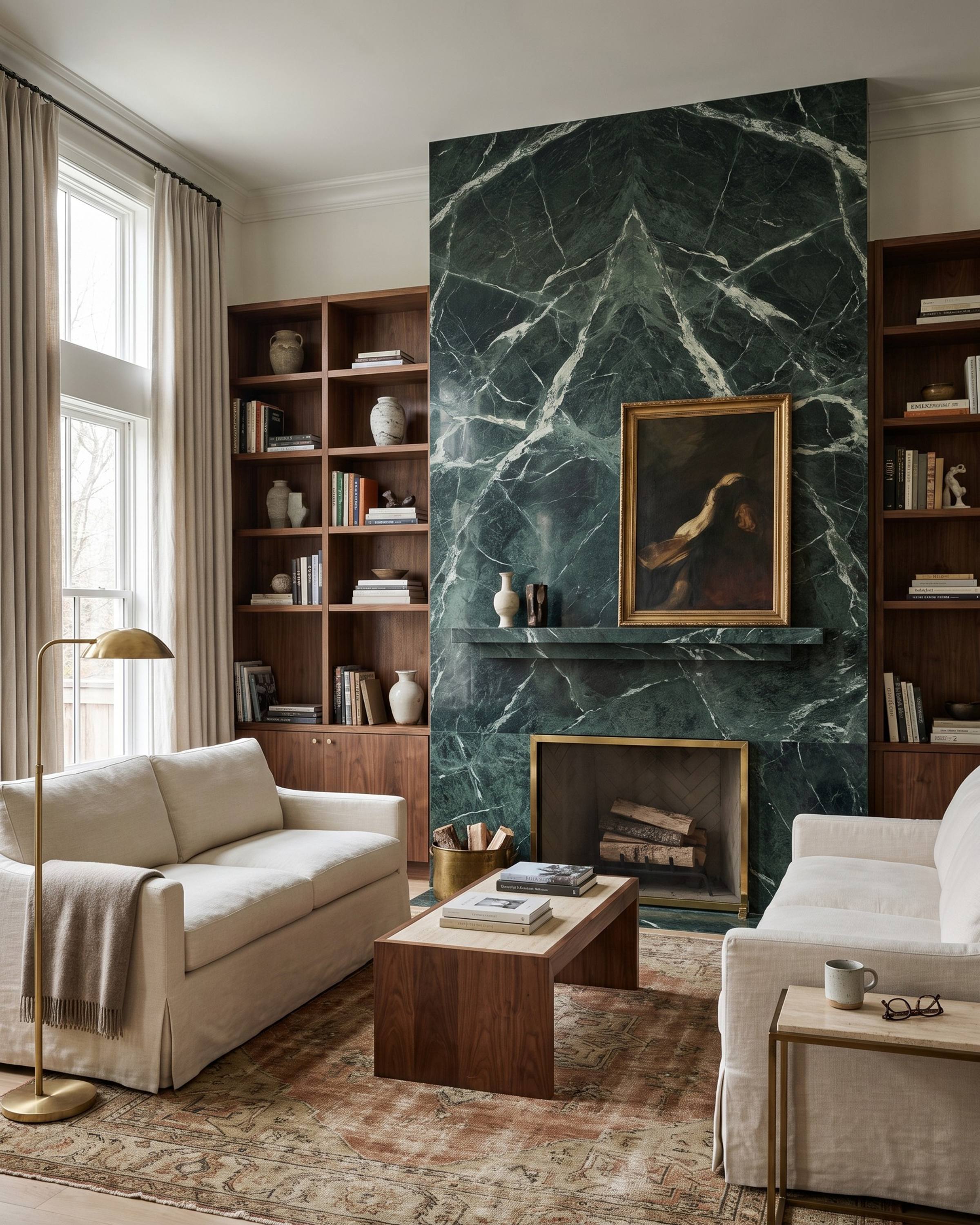
Verde Alpi
- What it is
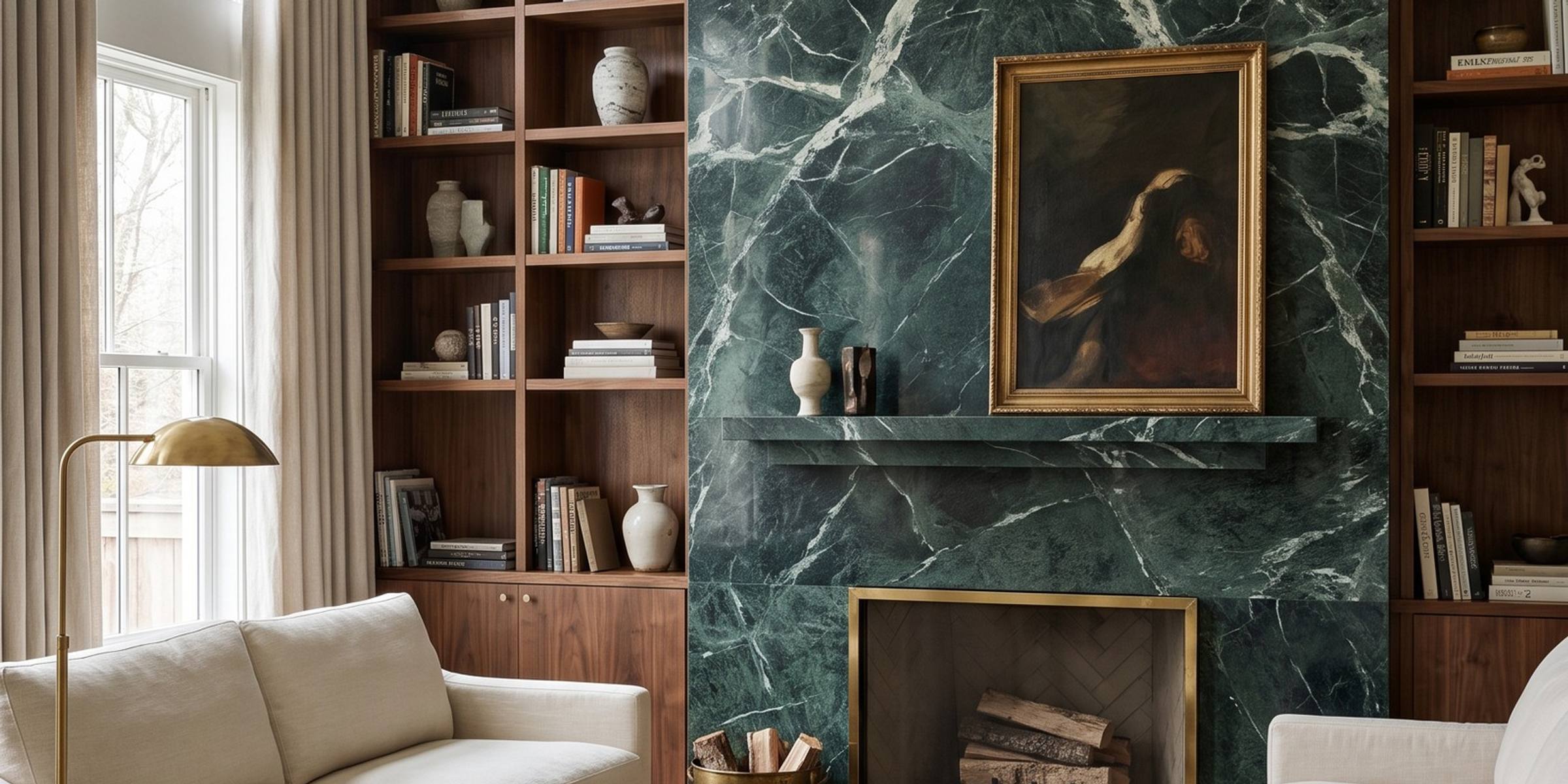
- A deep green stone from the Aosta Valley in northern Italy, forest green to near black with white and pale celadon veins that run in bold, broken lines. Sold as marble; geologically a serpentine stone, which makes it a little tougher than the whites.
- Where it works
- A fireplace wall, floor to ceiling and bookmatched; a bar front; a powder room in slab; a tabletop. Floors and stairs where a dark, enveloping room is the aim. One surface per room is enough.
- Living with it
- Honed, it is calm; polished, the contrast is ink-like but shows wear. The white veins are calcite and etch; the green body is less fussy. Slabs are often resin-reinforced or mesh-backed, which is normal; ask. Corners and cut-outs need an experienced fabricator.
- Pairs with
- Walnut, which warms it; smoked oak makes it modern. Bronze or aged brass, never chrome. Paint: a warm white limewash or Farrow & Ball School House White; bright white is too sharp.
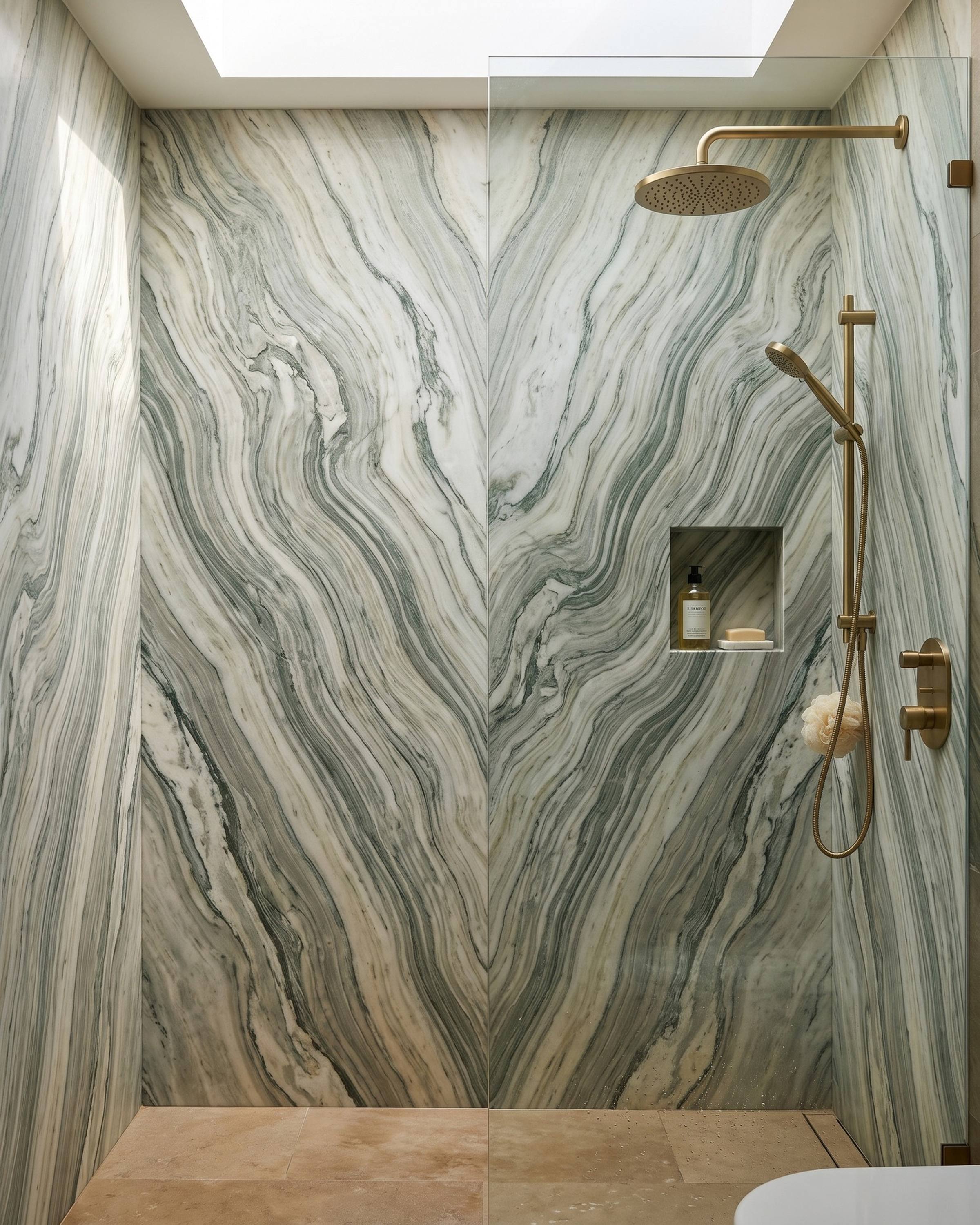
Cipollino
- What it is
- The marble of movement: pale green-grey with bands of cream, sage and silver that ripple across the slab like the layers of an onion, which is what the name means. Historically Greek, today mostly quarried in the Apuan Alps. The bands run one way, so the slab has a grain.
- Where it works
- A shower wall, a fireplace, a stair, slab wainscoting, the wall behind a vanity: any tall surface where the bands can run unbroken. Bookmatched, two slabs mirror into one drawing. Run the bands vertically to make a room taller, horizontally to widen it.
- Living with it
- A normal marble underneath: acid-sensitive, sealed, cleaned with a neutral soap. Honed is the right finish for walls and floors; polished pushes the contrast. Its real risk is the layout: a poor slab sequence breaks the flow, so template from the actual slabs.
- Pairs with
- Rift oak. Brushed brass. Paint: Farrow & Ball Shaded White or a soft sage; keep the rest of the room plain, the stone is the pattern.
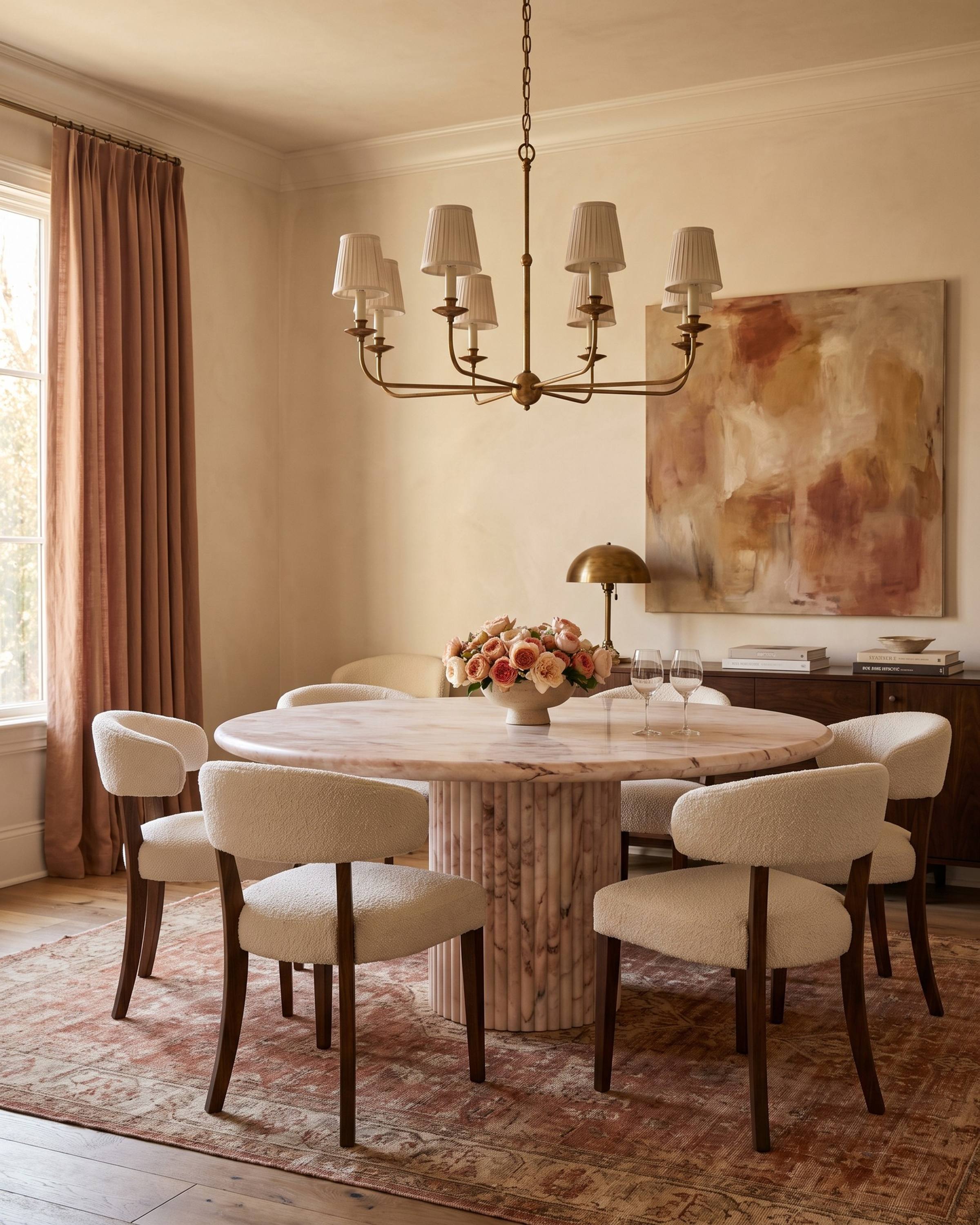
Rosa Portogallo
- What it is
- The pink marble of Portugal, from the Estremoz quarries in the Alentejo. A pale rose to blush ground with soft white, grey and deeper pink veins and a fine, even grain. Some lots lean cream, some clearly pink; Rosa Aurora is the pinker, more veined sister.
- Where it works
- A bathroom vanity, a powder room, a tabletop, a fireplace in a bedroom or sitting room, a bathroom floor. Beside oak, cream and unlacquered brass it reads warm rather than sweet. If you want burgundy instead, see Rosso Levanto, next.
- Living with it
- A true marble: it etches, stains without a sealer and takes a polish well. Honed, the pink softens to the colour of a shell; polished, it is a stronger pink. Easier to buy than the Italian colours and usually cheaper.
- Pairs with
- Oak and cream boucle. Unlacquered brass. Paint: Farrow & Ball Dimity or a warm white; avoid anything that reads pink on the walls, or the room turns to sugar.
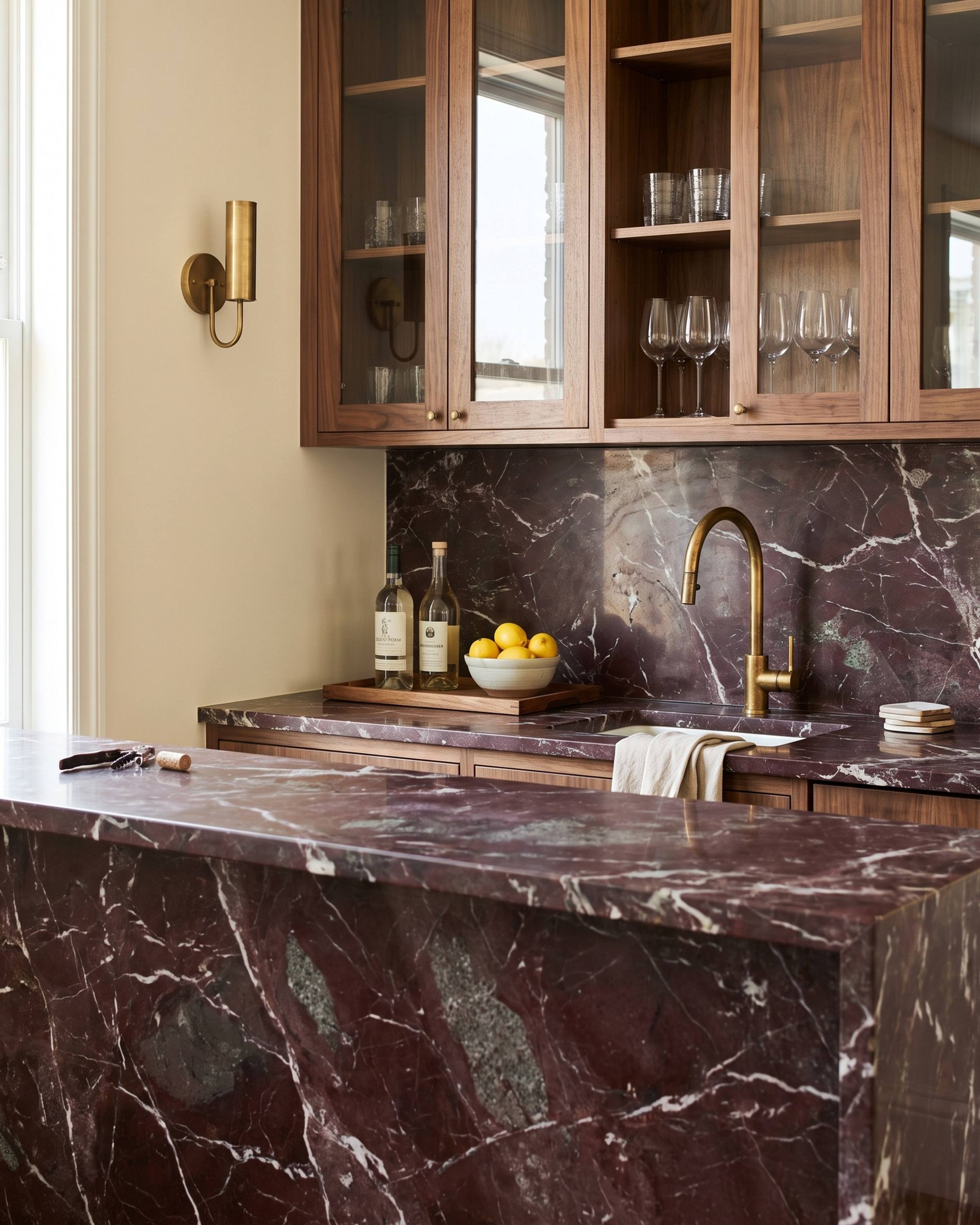
Rosso Levanto
- What it is
- A burgundy stone from Levanto, on the Ligurian coast of Italy: deep wine-red to maroon with white calcite veins and flecks of grey-green. Like Verde Alpi, a serpentine breccia that the trade calls marble. The darkest, richest red in this guide.
- Where it works
- A bar front and counter, a fireplace, a powder-room vanity, a console or coffee table, a small floor. Walnut and aged brass beside it, cream walls to give it air. One surface per room.
- Living with it
- Polished is its classic finish and the one that shows the red; honed goes softer and browner. The white veins etch, the red body less so. Often resin-filled, so inspect the slab. Red marble dates fast when used everywhere and never when used once.
- Pairs with
- Walnut, nothing paler. Aged brass. Paint: Benjamin Moore Linen White; oxblood or tobacco leather as the only other colour.
Nero Marquina
- What it is
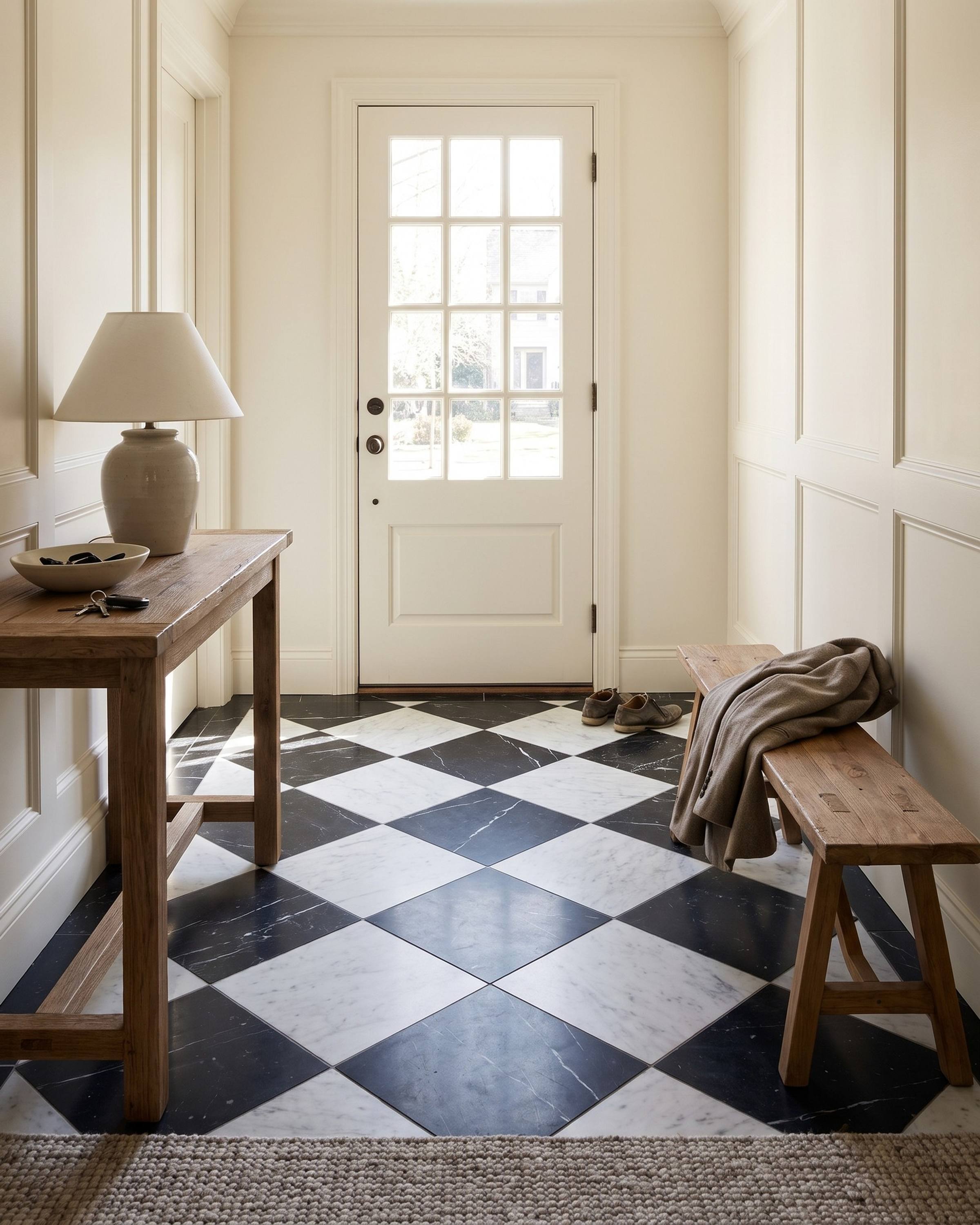
- The classic black-and-white marble, from Markina in the Basque Country of Spain. Deep black with sharp white veins that run fine or bold depending on the lot; cleaner and more graphic than Portoro, and far easier to buy.
- Where it works
- A fireplace, a vanity top, a checkerboard floor with Carrara, a bar counter, a coffee table, a backsplash. One black piece can organise a pale room. Not a shower floor, and not a kitchen counter for a cook.
- Living with it
- Black polished stone shows dust, water spots, soap film and every etch; honed hides most of that and is what we would specify. Seal it. Choose the lot for the depth of the black first and the veins second; poor slabs read grey.
- Pairs with
- White oak, or cabinets in black. Brass warms it, chrome sharpens it. Paint: Benjamin Moore White Dove; a pale room is what makes the black work.
Portoro
- What it is
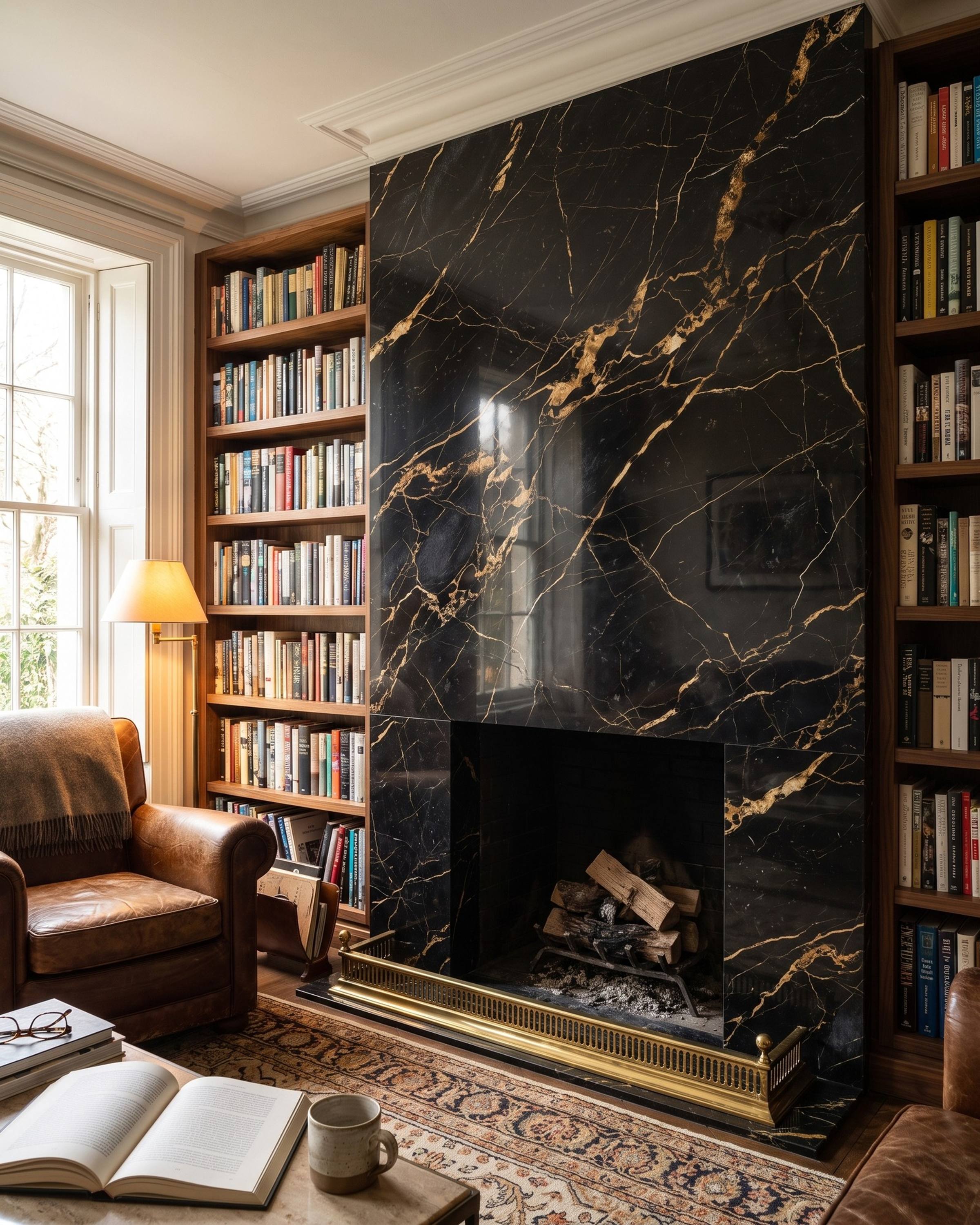
- Black marble with gold veins from Portovenere, near La Spezia in Liguria. The black is deep, the veins gold to amber and sometimes ivory, running in chains across the slab. Rare, and the most expensive stone here; the gold is what you are paying for.
- Where it works
- One focal plane: a fireplace, a wet bar, a powder room, the wall behind a vanity, a tabletop. Large pieces with as few seams as possible; cut small, it loses its effect. Never a whole room.
- Living with it
- Polished is the point; honed Portoro is quieter but loses the depth that justifies the price. It etches, needs sealing, and shows dulling and soap film like all dark polished stone. Fabrication must be first-rate: seams, mitres and thin edges are unforgiving.
- Pairs with
- Walnut and leather. Brass, matched to the veins. Paint: ivory walls, or Farrow & Ball Off-Black for a room that commits.
Limestone familySoft stone that runs through the house
Limestone, the travertines and Ceppo are all limestone underneath: the stones for a floor that continues from the hall into the kitchen and out to the terrace, for a fireplace wall, for the back of a bar, and, in Ceppo's case, for an island. Softer and more porous than marble, so always honed and sealed, and never a cook's counter. They make a house quiet in a way marble cannot.
Limestone
- What it is
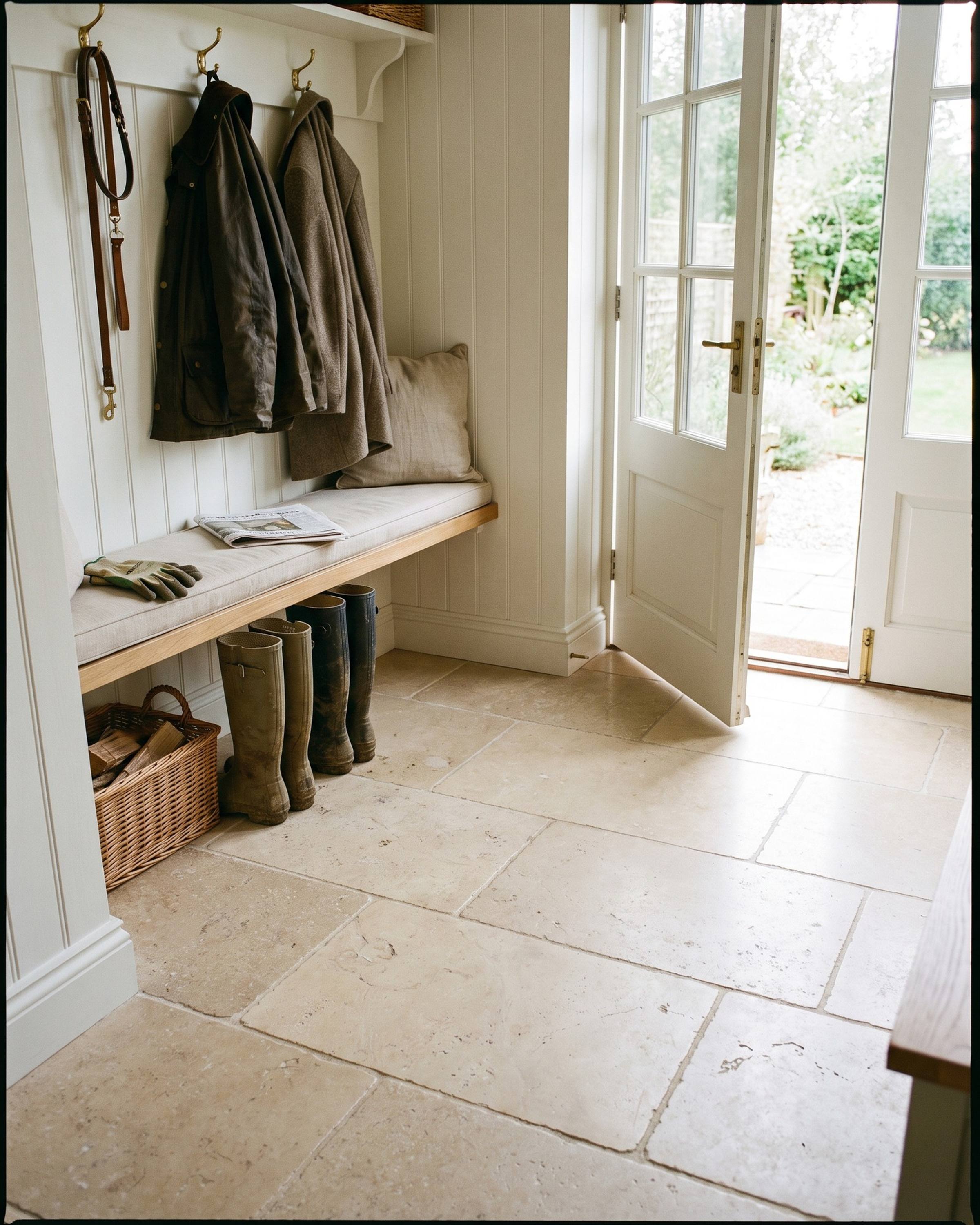
- A sedimentary stone of compressed shell and sediment, softer and more porous than marble, in cream, beige, buff and pale grey with small fossils and little veining. French, Portuguese, German and Indiana limestones are the ones we see most.
- Where it works
- Floors, especially with underfloor heating; a fireplace surround and hearth; a shower wall, a vanity top, a tub deck. It makes a whole floor quiet in a way marble cannot. Not a kitchen counter: it etches like marble and stains faster.
- Living with it
- Honed or brushed, never polished. Sealed when laid and resealed every year or two. Wipes clean; grit scratches it, so mats at the doors. Some limestones are nearly as hard as marble and some crumble, so ask for the absorption figure before buying.
- Pairs with
- Oak floors where the stone stops. Iron, bronze or aged brass. Paint: Farrow & Ball Pointing, which matches most beige limestones.
Travertine
- What it is
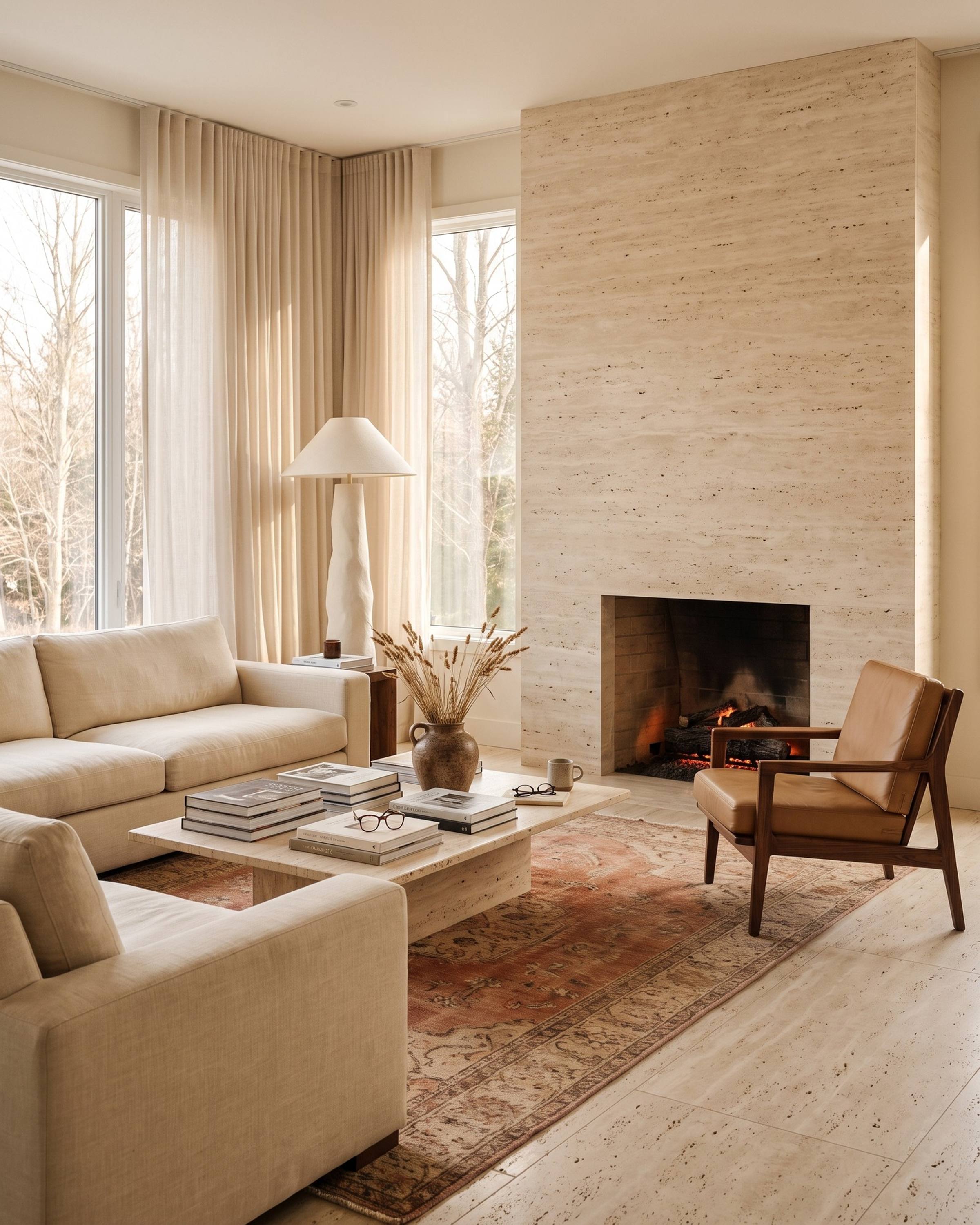
- A limestone laid down by hot springs, full of small holes, in ivory, cream and walnut. The classic quarries are at Tivoli near Rome; most slabs today come from Turkey. Cut across the bed it is cloudy; cut with it, vein-cut, it shows linear bands. Ask for Navona or Romano Classico: ivory, vein-cut, honed.
- Where it works
- Floors in a living room, hall or bath; a fireplace wall; a coffee or dining table; a shower wall. On a floor it wants furniture: linen, oak, wool. A honed and filled slab can be a vanity top; a kitchen counter only for someone who likes patina.
- Living with it
- Unfilled, the holes collect dirt on a floor, so they are grouted flush when laid or left open on a wall. It etches and stains like limestone, so seal it. Honed and tumbled hide wear; polished travertine is the 1990s version, avoid it. Mid-price as tile, more as slab.
- Pairs with
- Oak, walnut and linen. Brass. Walls in a warm white limewash or a clay plaster; travertine and plaster are the same colour family.
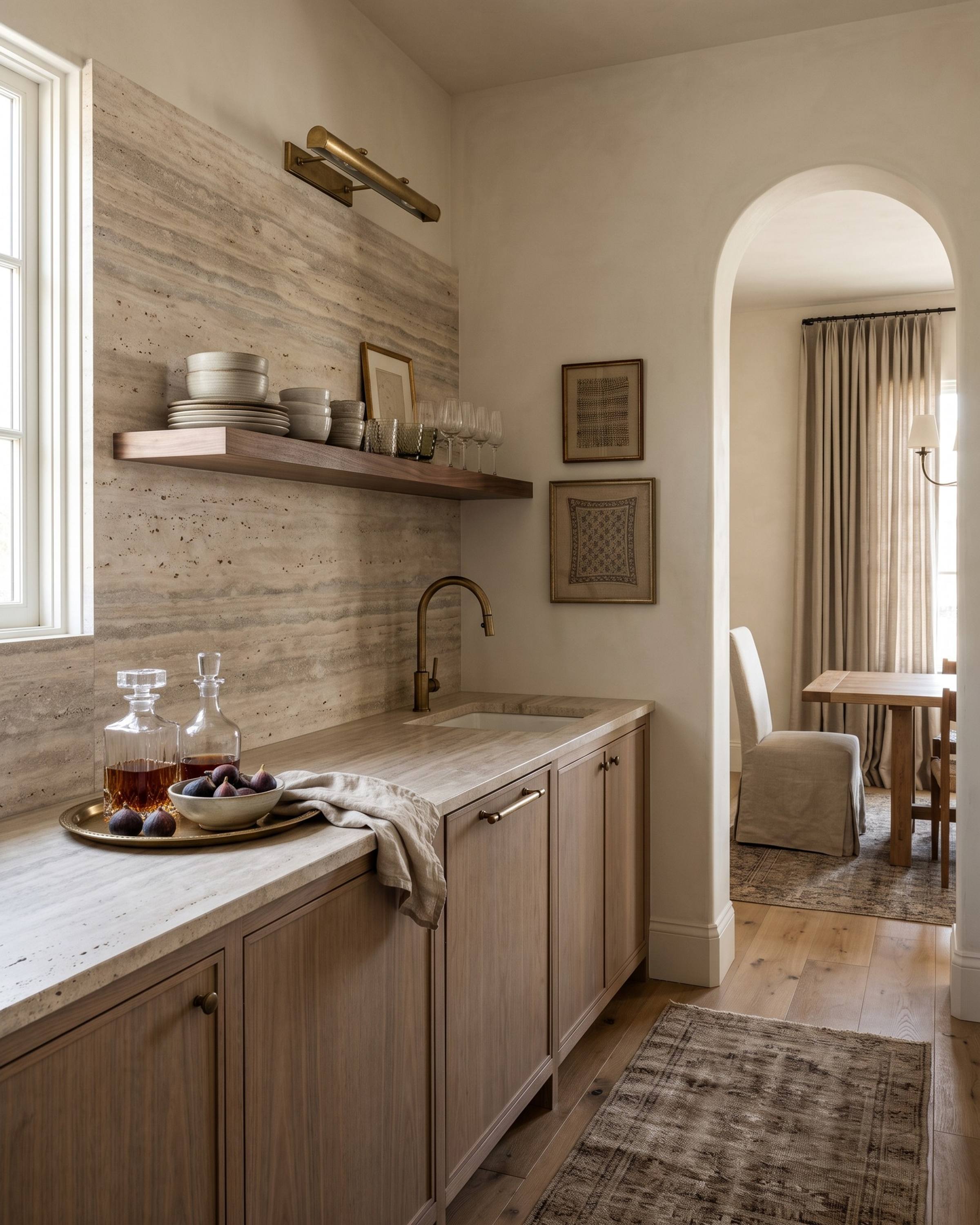
Silver Beige travertine
- What it is
- Vein-cut travertine in greige: fine horizontal bands of sand, taupe and soft silver-grey, usually filled and honed. Mostly Turkish. The cooler sister of the ivory travertines, and the one that reads grey in a north-facing room.
- Where it works
- A bar or pantry wall with the counter in one stone, a fireplace, a feature wall, a floor. Run the bands horizontally and let them continue across slabs. Beside bleached walnut, oak and brass it stays warm.
- Living with it
- As travertine: porous, sealed, etches with acid, honed or brushed, never polished. Filled pores can open with wear and are refilled. Affordable as tile, more as slab.
- Pairs with
- Bleached walnut or white oak; it needs the wood's warmth. Brass. Paint: Farrow & Ball School House White. Skip grey paint next to it; the room goes flat.
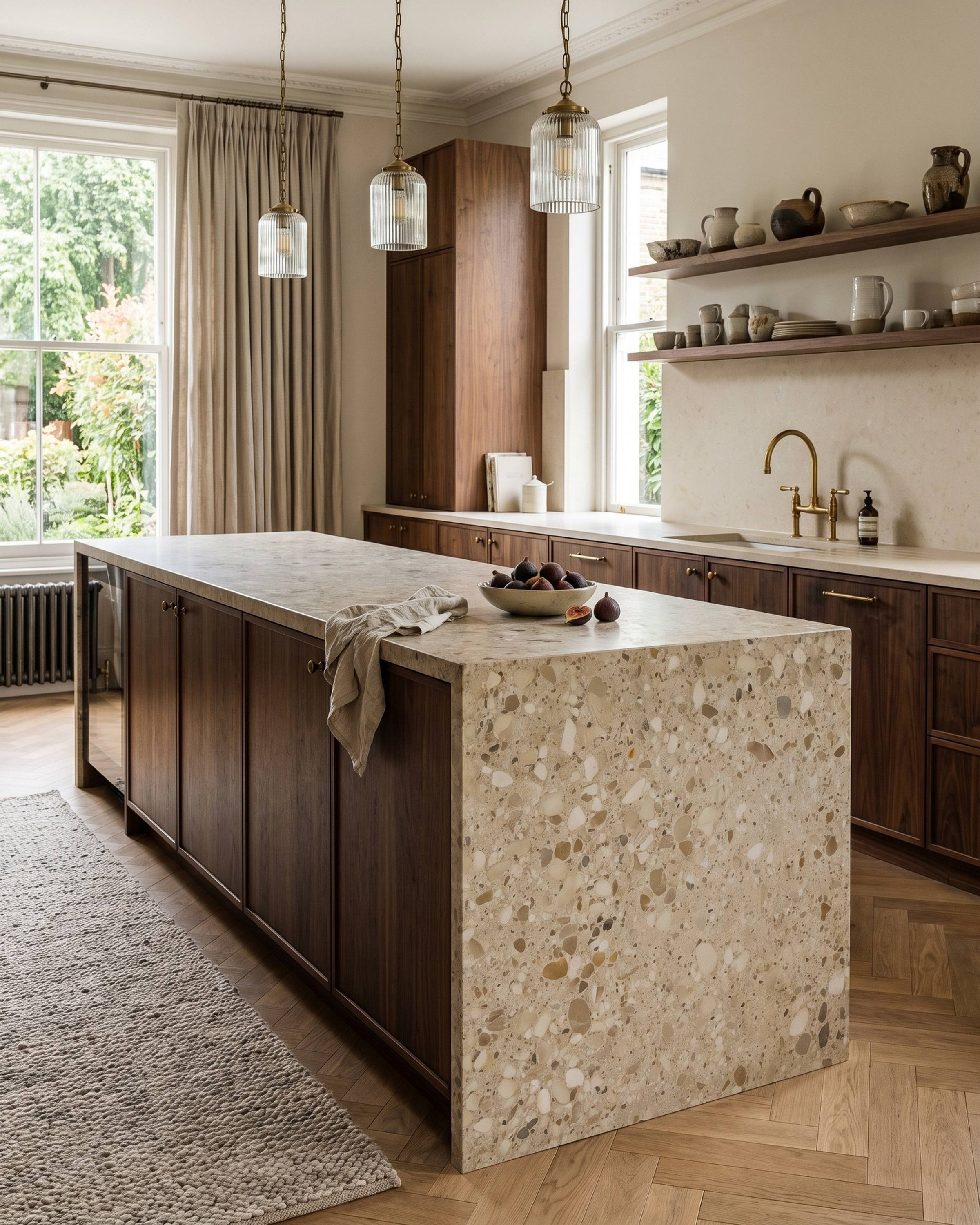
Ceppo di Gré
- What it is
- A conglomerate from the hills above Lake Iseo in Lombardy: rounded river pebbles in cream, tan, ochre and grey held in a sandy limestone matrix. Milan's pavement and façade stone since the 1930s, and the natural stone that terrazzo imitates. Warm lots read beige; common lots read grey, so choose the slab.
- Where it works
- An island top, a counter, a floor, a table, stair treads, a fireplace. One Ceppo surface per room, with plain stone or wood around it; two patterns of pebbles fight.
- Living with it
- Honed and sealed; the matrix is limestone, so it etches and stains like one, and a pebble can lift at a cut edge, so use a simple eased profile. Harder to source than the Italian marbles, and priced like a mid-range marble once imported.
- Pairs with
- Dark walnut or natural oak. Brass. A plain cream limestone or quartzite on the other counters. Paint: Farrow & Ball Pointing.
Stone by roomWhere each one works
| Stone | Kitchen counter | Vanity | Shower wall | Floor | Fireplace |
|---|---|---|---|---|---|
| Quartzite | yes | yes | yes | yes | yes |
| Soapstone | yes | yes | yes, slab | rarely | hearth, yes |
| Carrara | honed, with patina | yes | yes | yes | yes |
| Calacatta Gold | island, with patina | yes | yes | low traffic | yes |
| Calacatta Monet | island, with patina | yes | yes | low traffic | yes |
| Statuario | statement only | yes | yes, slab | low traffic | yes |
| Arabescato Corchia Max | island, with patina | yes | yes, slab | low traffic | yes |
| Calacatta Viola | no | powder room | statement only | no | yes |
| Verde Alpi | no | powder room | statement only | honed only | yes |
| Cipollino | no | yes | yes, bookmatched | honed only | yes |
| Rosa Portogallo | no | yes | yes | honed only | yes |
| Rosso Levanto | bar only | powder room | no | small, honed | yes |
| Nero Marquina | no | honed only | walls only | checkerboard | yes |
| Portoro | no | powder room | no | no | statement only |
| Limestone | no | yes | sealed | yes | yes |
| Travertine | no | filled, honed | filled | yes | yes |
| Silver Beige travertine | no | filled, honed | filled | yes | yes |
| Ceppo di Gré | island, with patina | yes | no | yes | yes |
How to choose
| If… | Consider… |
|---|---|
| A counter you cook on every day | Quartzite, soapstone or honed black granite |
| Marble in the kitchen, eyes open | Honed Carrara or Calacatta Gold, an eased edge, sealed |
| A kitchen that is one composition | Calacatta Monet or Arabescato Corchia Max on the range wall, plain cabinets |
| One statement in the house | Calacatta Viola, Verde Alpi, Rosso Levanto or Portoro, on a fireplace, a bar or a powder room |
| A bathroom that stays calm | Carrara or limestone, honed, floor to wall |
| A tall wall that reads as a drawing | Cipollino, Statuario or Corchia Max, bookmatched |
| A warm floor through several rooms | Limestone or honed travertine, with underfloor heating |
| Pattern without veins | Ceppo on an island or a floor, plain stone everywhere else |
| Pink or red without a theme | Rosa Portogallo on a vanity or a table |
| A black piece in a pale room | Nero Marquina, honed |
| Budget first | Carrara, soapstone, limestone or travertine before the Italian colours |
Two rules we work by. One statement stone per house, seen whole, with quieter stone everywhere else. And decide the finish before the stone: honed on anything white or pale, polished only where the stone is defined by it, which here means Portoro, Nero Marquina and Rosso Levanto.
Common questions
Can you use marble in a kitchen?
Yes, if you accept that it will etch and mark. Choose honed Carrara or Calacatta Gold, an eased or rounded edge, and seal it once a year. Put it on the island or the baking counter and something harder by the range and the sink. If every mark will bother you, choose a quartzite that looks like marble instead.
Quartzite or marble: what is the difference?
Marble is calcium carbonate and etches with acids; quartzite is mostly quartz, far harder, and does not etch, though it can stain and is sealed. Taj Mahal and Mont Blanc quartzite look close to Calacatta and cost about the same or more. Test a sample with lemon juice: if it dulls, it is not true quartzite.
How often does stone need sealing?
Marble, limestone, travertine and quartzite take an impregnating sealer about once a year; soapstone and granite rarely or never. Test by leaving a drop of water on the counter: if it darkens the stone within a few minutes, reseal. A sealer slows staining; it does not stop etching.
Polished or honed?
Honed, for almost everything pale: it is matte, hides etches and reads current. Polished shows every etch and water spot but gives dark stone its depth, so Portoro, Rosso Levanto and Nero Marquina are usually polished on a fireplace or bar and honed on a counter. Honed stone is slightly more open to stains, so it is sealed as carefully.
What is bookmatching, and how do I choose a slab?
Bookmatching is two consecutive slabs from the same block, opened like a book so the veins mirror. Choose at the stone yard, not from a sample: see the full slab in daylight, ask for the slabs in sequence, reserve them, and have the fabricator draw the layout so the veins fall where you want them and the seams where you don't.
One stone for the whole house, or several?
One quiet stone for continuity (Carrara, limestone or a cream quartzite) and one statement stone in one place is the usual answer. Three stones is the most a house carries well. Vary the finish and the cut rather than the colour when the same stone appears in two rooms.
What about quartz and porcelain?
Both are engineered: no etching, no sealing, and a consistent pattern. Quartz can scorch and fade in sun; porcelain is thin and chips at the edges. They are good counters and they are not stone. A later guide, Countertop materials compared, puts them beside stone and wood.